Data correction — 13 October 2026
Results regeneratedEarlier versions of this dashboard reported figures that did not
come from NASA OSDR. The data layer returned values written as
literals in its own source — first produced by
numpy.random.normal(), later replaced by hand-typed numbers that
still did not match the archive: 36 lettuce samples against the archive's 24,
calcium about three times the measured value, and a copper column for a study
that never measured copper.
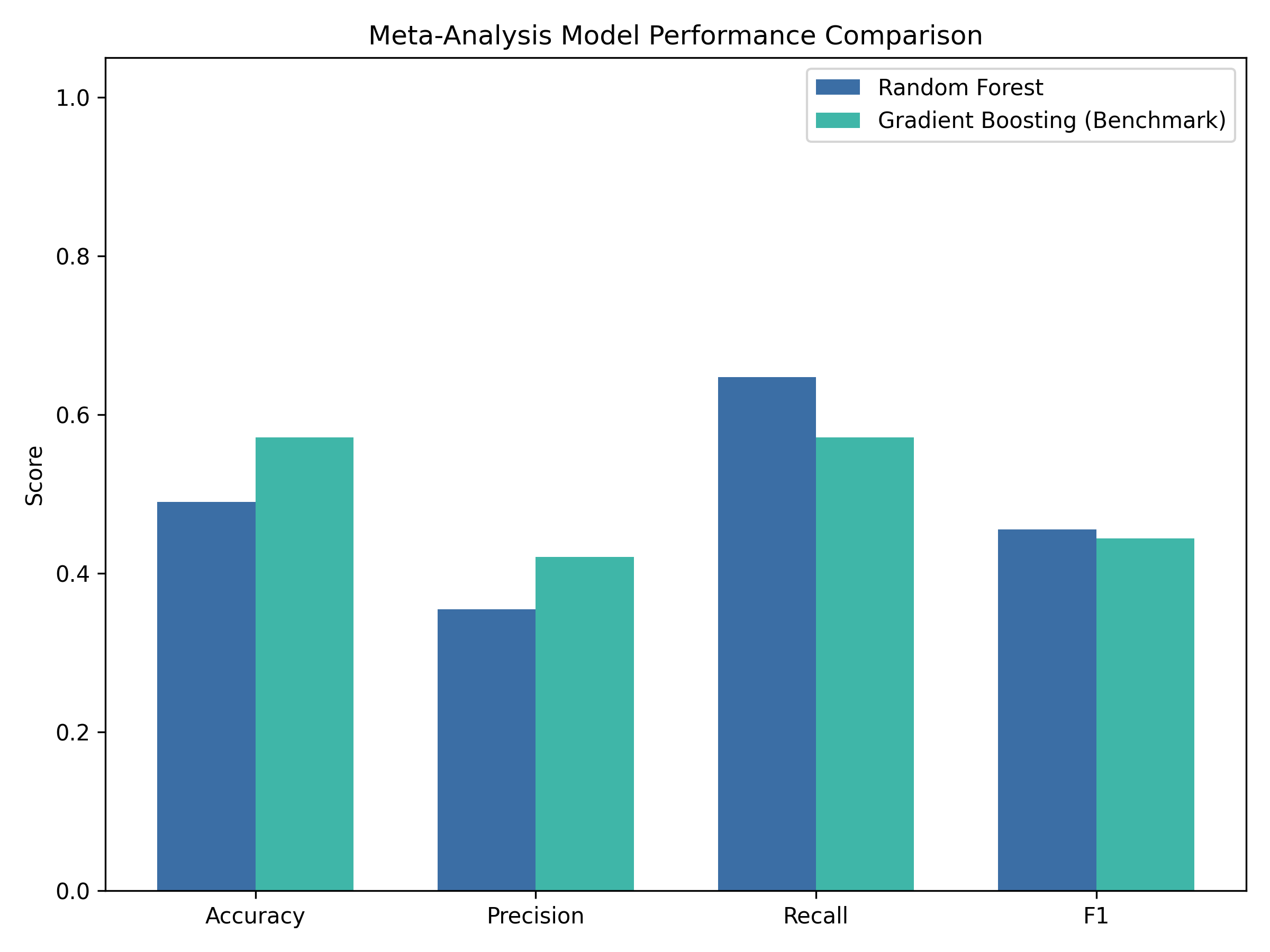
The data layer now downloads and uses the archive, with no synthetic fallback, and every derived result on this site has been regenerated. The regenerated results do not support the earlier conclusions: classification accuracy falls from 83.3%/89.6% to 0.490/0.572 — at or below chance; the elemental→antioxidant regression, scored out-of-fold instead of in-sample, gives R² of −0.90 and −2.16, worse than predicting the mean; and of five analytes previously reported significant, only potassium and sulfur survive FDR correction.
Cohort as fetched: 24 lettuce (OSD-745; 11 flight, 13 ground) and 36 mizuna (OSD-655; 18, 18). Full detail in the correction note.
Multi-Crop Meta-Analysis of Spaceflight-Grown Crops on the ISS
Synthesizing data from NASA OSDR studies OSD-745 (Lettuce), OSD-655 (Mizuna), and OSD-780 (Food Safety Microbiology) grown in Veggie hardware.
VEG-01A & 01B (Lettuce)
Dates: May–Jun 2014 & Jul–Aug 2015
Validation of Veggie hardware and first astronaut on-orbit crop consumption.
VEG-03A (Lettuce)
Dates: Oct-Dec 2016 | SpaceX-8
Repetitive cut-and-come-again canopy harvesting trial.
VEG-04A & 04B (Mizuna)
Dates: Jun–Jul & Oct–Nov 2019 | SpaceX-16/18
Pick-and-eat space crop production, sensory, and microbiological safety testing.
10+
Nutrients & Assays
5
ISS Spaceflight Missions
60
Samples with elemental data
24 lettuce + 36 mizuna
Elemental Comparison (Flight vs Ground)
Bar ProfileNutritional Profile Overview
Radar TopologyMicrobiological Food Safety Analysis (APC & YMC Counts)
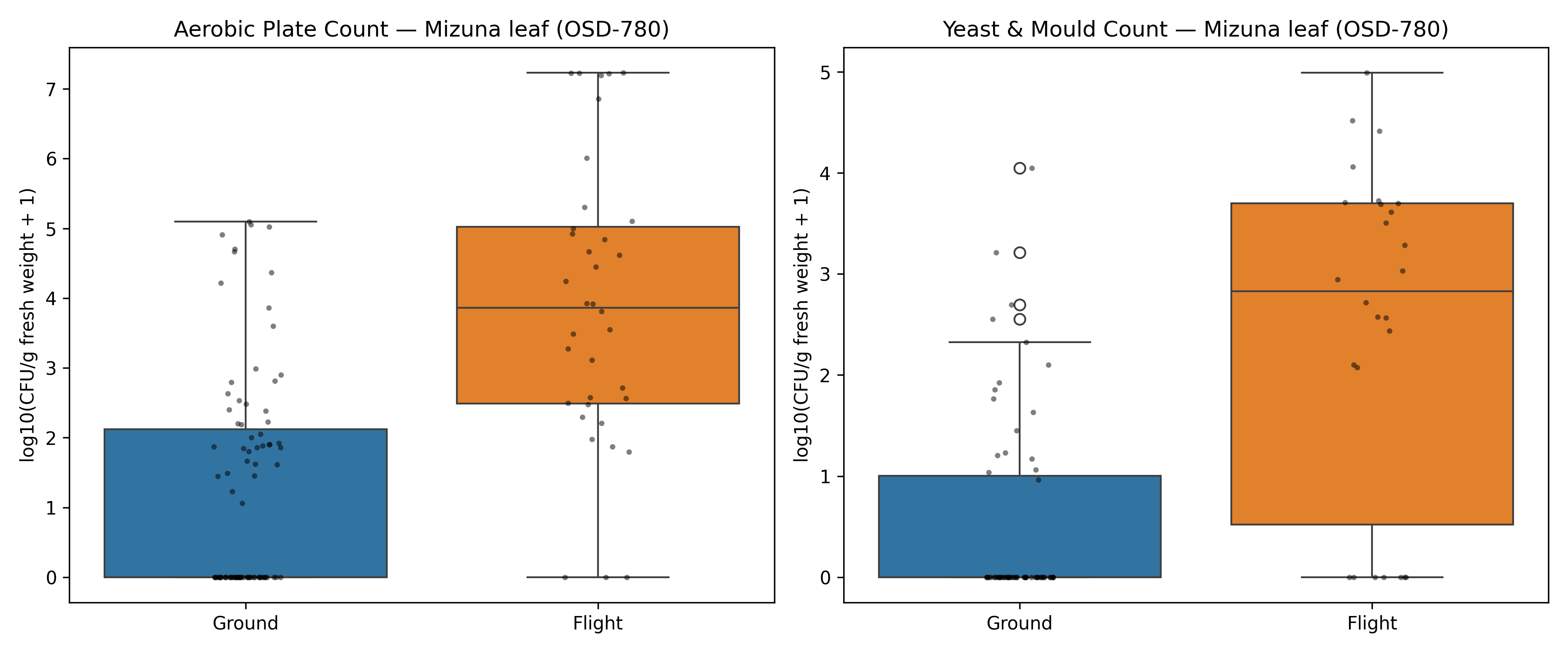
OSD-780 (VEG-04 only)Aerobic Plate Counts (APC) and Yeast & Mould Counts (YMC) on Mizuna leaf tissue, from OSD-780. Plotted as log10(CFU/g + 1): raw counts span zero to 1.7×10⁷ CFU/g and over half the ground samples are exactly zero.
Rebuilt from OSD-780 on 13 October 2026. This section previously read per-sample APC and YMC values off the nutrient table. Those columns were part of the fabricated data and were not measurements. It also showed counts for lettuce: OSD-780 covers the VEG-04 missions only, so no lettuce microbiology exists in the archive. Only leaf tissue is used here — the study also samples soil, root, wick, water and hardware swabs, which are not edible tissue.
Flight tissue carries a substantially higher microbial load: median aerobic count 7,380 CFU/g in flight (n=36) against 0 in ground controls (n=87), p = 7.6×10⁻¹⁰. Sanitisation is labelled on ground samples only, so the matched comparison restricts ground to unsanitised samples — the difference persists (7,380 vs 41 CFU/g, p = 2.0×10⁻⁶).
The earlier safety statement has been withdrawn. It claimed all harvested leaves fell well within < 5.0 log₁₀ CFU/g. Twelve of 123 aerobic leaf measurements (9.8%) exceed that — nine flight, three ground — with a flight maximum of 7.23 log₁₀. No acceptance threshold is asserted here; what is shown is that the previous claim is contradicted by the archive data.
Detailed Measurements Master Matrix
FAIR Data Matrix| Sample ID | Crop | Mission | Condition | Fe (mg/g) | K (mg/g) | Na (mg/g) | P (mg/g) | S (mg/g) | Zn (mg/g) | Ca (mg/g) | Mg (mg/g) | Phenolics | ORAC |
|---|
PCA of Nutritional Profiles
Meta-Analysis (OSD-745 & OSD-655)Joint PCA of lettuce and mizuna on the 11 features with complete coverage (55 samples). PC1 separates the two crops. Lettuce groups by mission rather than by flight or ground; mizuna flight samples tend to sit higher on PC2, with overlap. Hover over points for sample metadata.
Feature Importance
Random ForestMean Decrease Impurity (MDI) across the 11 features the classifier uses (nine elements plus phenolics and ORAC). Regenerated from the archive data, the ranking is Potassium, Sodium and Sulfur. Because the classifier itself performs at chance (see the metrics above), this shows what the model attended to — it does not identify validated spaceflight discriminators.
Statistical Test Results
Mann-Whitney U + FDRHypothesis testing with Benjamini-Hochberg FDR correction and Cohen's d effect sizes comparing Flight vs. Ground Control tissues.
| Analyte | Raw p-value | FDR p-value | Cohen's d | Significance |
|---|
Classification Performance
LOMOCVLeave-One-Mission-Out Cross-Validation on joint multi-crop dataset.
Biochemical Regression
WithdrawnThese figures have been withdrawn. This card previously reported an ORAC R² of 0.528 and a phenolics R² of 0.491. Both were written directly into the page and appear in no result file in this repository.
They have not been replaced. The regression this repository does
compute is fit and scored on the same rows
(analysis/ml_pipeline.py), so its R² of 0.96–0.99 is
in-sample and is not a generalisation estimate either. No metric is
shown here because none can currently be sourced.
The underlying NASA assays (ORAC, total phenolics, anthocyanin) were listed in the OSDR file manifests throughout but had never been downloaded. They have since been obtained and analysed: blocking on mission, no assay shows a flight effect at FDR 0.05 in either crop. Full detail in the correction note.
Tabular Foundation Model Benchmarking (Nature 2025)
Hollmann et al., 2025We set out to benchmark TabPFN (Tabular Prior-data Fitted Network) against Random Forest. TabPFN needs a license token to download its weights; without one the pipeline falls back to Gradient Boosting, and that fallback is what the benchmark column shows. Neither model separates flight from ground.
Performance Comparison Matrix
| Evaluation Metric | Random Forest (LOMOCV) | Benchmark model | Difference |
|---|---|---|---|
| Accuracy | — | — | — |
| Precision | — | — | — |
| Recall | — | — | — |
| F1 Score | — | — | — |
| Cross-Species Generalization (LOCOCV) | Withdrawn
No leave-one-crop-out split was run — every
LeaveOneGroupOut in analysis/ groups on
mission. On the real OSDR data, cross-crop transfer falls
below a stratified-dummy baseline (balanced accuracy
0.486 vs 0.600). Details. |
||
Study Methodology
Lettuce plants (Lactuca sativa cv. 'Outredgeous') were grown in Veggie pillows containing solid, porous, arcillite (calcined clay) substrate in two different blends (Blend 1: 100% sized to 600 µm–1 mm or Blend 2: a 1:1 ratio of that size to 1–2 mm) and controlled-release fertilizer (Nutricote 18-6-8, Florikan, Sarasota, FL, United States). Plants were grown for 33 to 56 days aboard the ISS under a red, blue, and green LED array providing approximately 200 µmol/m²/s of photosynthetically active radiation (PAR). Ground control experiments were conducted in controlled environment chambers at KSC under matching temperature, relative humidity, carbon dioxide concentration, and light regimes with a 24-72 hour delay.
Harvested leaves were stored at -80°C and returned to Earth. Nutritional assays included:
- Elemental Profiling: Inductively Coupled Plasma Optical Emission Spectroscopy (ICP-OES) for Fe, K, Na, P, S, Zn, Ca, Mg, Mn, and Cu (expressed as mg/g dry weight).
- Total Phenolic Content: Folin-Ciocalteu spectrophotometric assay, expressed as gallic acid equivalents (GAE mg/g dry weight).
- Anthocyanin Content: pH differential spectrophotometric assay, expressed as cyanidin-3-glucoside equivalents (mg/g dry weight).
- Oxygen Radical Absorbance Capacity (ORAC): Fluorescein decay antioxidant capacity assay against Trolox standard (µmol TE/g dry weight).
Analysis & ML Pipeline
Our analytical and machine learning pipeline is structured as follows:
- Data Harmonization: Merged metadata (missions, conditions) and assay measurements, resolving column types and standardizing units.
- Dimensionality Reduction: Standardized nutritional variables (z-score scaling) and applied Principal Component Analysis (PCA) to extract eigenvectors and coordinates, determining sample separation along the first two principal components.
- Random Forest Classification: Trained an ensemble of 100 decision trees to classify Flight vs. Ground Control samples using the 11 features with complete coverage (nine elements plus phenolics and ORAC). Evaluated with Leave-One-Mission-Out Cross-Validation (LOMOCV), which tests generalization to an unseen spaceflight; accuracy was at chance. Feature importance is Gini (mean decrease in impurity); SHAP and permutation importance are computed only in the lettuce-only pipeline.
- Tabular Foundation Model Benchmarking: Written for TabPFN (Tabular Prior-data Fitted Network) as described by Hollmann et al. (Nature 2025). Unlike gradient boosting trees or standard neural networks, TabPFN is a pre-trained transformer model optimized for zero-shot, prior-data fitted classification on small tabular datasets, It did not run here: without a license token the pipeline falls back to Gradient Boosting, and that fallback is the benchmark shown.
- Antioxidant Capacity Prediction: Implemented Random Forest regression to predict biochemical outcomes (ORAC and Phenolics) based on multi-element profiles, measuring model performance via R² and root-mean-squared error (RMSE). Scored out-of-fold on lettuce (n = 24), R² was −0.90 for phenolics and −2.16 for ORAC, worse than predicting the mean.
- Statistical Validation: Conducted non-parametric Mann-Whitney U tests for all analytes, applying false discovery rate (FDR, Benjamini-Hochberg) and Bonferroni corrections to prevent family-wise error rate inflation, and computed Cohen's d effect sizes.
Data Provenance (FAIR)
All data is sourced from NASA OSDR studies OSD-745 (Lettuce), OSD-655 (Mizuna Nutrition), and OSD-780 (Microbiology) following FAIR data principles.
Citations
% 1. Spaceflight Lettuce Nutrition & Safety (OSD-745)
@article{khodadad2020microbiological,
  title={Microbiological and nutritional analysis of lettuce crops grown on the International Space Station},
  author={Khodadad, Christina L and Hummerick, Mary E and Spencer, LaShelle E and Dixit, Anirudha R and Richards, Jeffrey T and Romeyn, Matthew W and Smith, Trent M and Wheeler, Raymond M and Massa, Gioia D},
  journal={Frontiers in Plant Science},
  volume={11},
  pages={199},
  year={2020},
  doi={10.3389/fpls.2020.00199}
}

% 2. Spaceflight Mizuna Pick-and-Eat Testing (OSD-655 & OSD-780)
@article{bunchek2024pick,
  title={Pick-and-eat space crop production flight testing on the International Space Station},
  author={Bunchek, Jess M and Hummerick, Mary E and Spencer, LaShelle E and Romeyn, Matthew W and Young, Millennia and Morrow, Robert C and Mitchell, Cary A and Douglas, Grace L and Wheeler, Raymond M and Massa, Gioia D},
  journal={Journal of Plant Interactions},
  volume={19},
  number={1},
  pages={2292220},
  year={2024},
  publisher={Taylor \& Francis},
  doi={10.1080/17429145.2023.2292220}
}