NASA OSDR home page
Explore the OSDR home page.
Welcome to our homepage! Here’s what you’ll find:
Latest Data Releases: Stay up-to-date with new data.
Space Biology News: Catch the latest in space biology.
Research Opportunities: Get involved in ongoing research.
Open-Access Projects: Access our recent projects freely.
 (1).png)
The OSDR home page content. A - Navigation menu. B - Data Repository. C - Submission Portal. D - Latest News. E - Latest Datasets. F - Open Science Projects.
A - Navigation menu: Provides links to the resources within the OSDR website. It contains “About”, “Data & Tools”, “Research & Resources”, “Working Groups” and “Help” pages.
B - Data Repository: Access a GUI for finding space biology data.
C - Submission Portal: A GUI designed for data integration and sharing.
D - Latest News: A summary of the latest space biology news.
E - Latest Datasets: A summary of the latest datasets received and processed by the OSDR team.
F - Open Science Projects: Summary of the open science projects that comprise the OSDR.
About
About: The “About” drop-down menu from the OSDR home page provides information about OSDR groups and resources. Here’s a detailed overview of what you can explore:
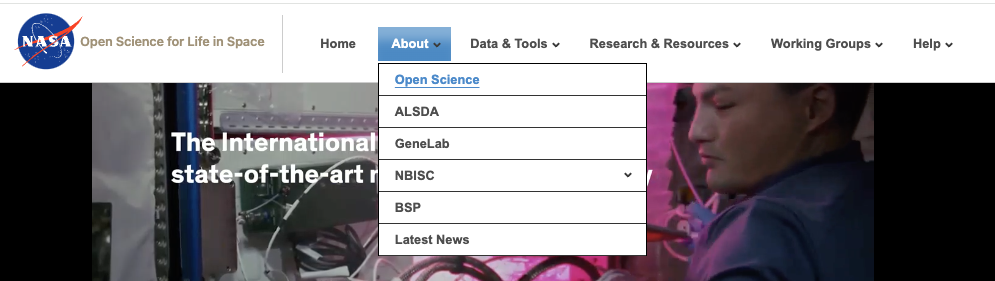
"Open Science for Life in Space". To the right of the text is the website's navigation menu the "About," option has been selected revealing subpages “Open Science”, “ALSDA”, “GeneLab”, “BPS”, and “Latest News”
Open Science: The NASA Open Science Data Repository (OSDR) enables access to space-related data from experiments and missions that investigate biological and health responses of terrestrial life to spaceflight. The goal of OSDR is to enable multi-modal and multi-hierarchical fundamental space life science data, including ‘omics, phenotypic, physiological, behavioral, hardware, and environmental data, to be reused toward basic science, applied science, and operational outcomes for space exploration and knowledge discovery.
ALSDA: The Ames Life Science Data Archive (ALSDA) provides public access to a wide range of data from space-relevant experiments and missions, including physiological, phenotypic, bioimaging, video, behavioral, hardware, and environmental telemetry data. The goal of ALSDA is to enable the reuse of this fundamental space life science data towards basic science, applied science, and operational outcomes for space exploration and knowledge discovery. ALSDA has recently been integrated into the NASA Open Science Data Repository (OSDR), which also includes the NASA GeneLab and the NASA Biological Institutional Scientific Collection, in order to improve the Findability, Accessibility, Interoperability, and Reusability (FAIR) of its data.
GeneLab: GeneLab is a NASA project that aims to facilitate information sharing, foster innovation, and increase the pace of scientific discovery from rare and valuable space biology experiments. It provides a comprehensive database that hosts a growing collection of omics data generated from spaceflight and spaceflight analog experiments, enabling scientists to upload, download, store, search, share, transfer, and analyze this data. GeneLab’s primary goal is to maximize the utilization of the valuable biological research conducted in space by generating and publishing omics data, and it includes a state-of-the-art sample processing and high-throughput sequencing laboratory to process samples and raw data in a consistent manner.
BSP: NASA Biological Biospecifimen sharing program aims to enhance research efficiency and transparency, and improve handling of scientific samples and data. The BSP team develops and adheres to a process flow consisting of planning and coordinating activities, dissection of the biospecimens, and distribution of tissues.
NBISC: NASA Biological Institutional Scientific Collection (NBISC), is a biorepository contains tens of thousands of unused non-human samples collected from NASA-funded spaceflight investigations and correlative ground/analogue studies. The purpose of NBISC is to receive, store, document, preserve, and make the collection available to the scientific community. This program facilitates the sharing of biological samples collected during spaceflight experiments. Gain insights into the importance of biospecimen sharing for advancing space biology research and understanding the effects of space flight-related environments and stimuli on living organisms.
Latest News: Stay up-to-date with the latest news and developments in NASA’s space biology research. Read about recent scientific discoveries, upcoming missions, and other exciting initiatives in space biology.
Data & Tools
Data & Tools: The “data & tools” drop-down menu provides information about OSDR data and tools. Here’s a detailed overview of what you can explore:
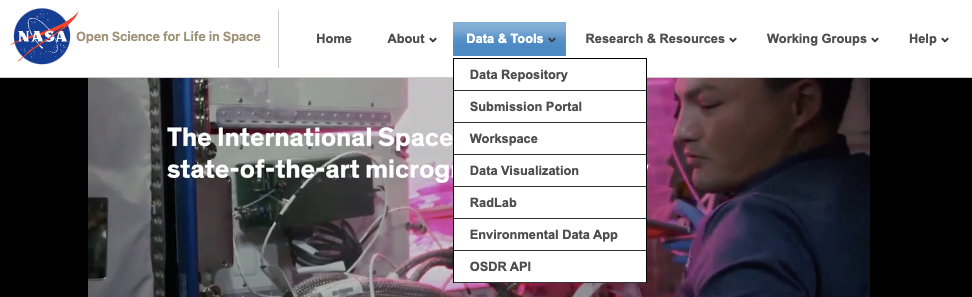
Data Repository: Links to the data repository, where users can access space biology-centric data. Contains datasets from various space biology studies including data on gene expression, proteomics, and physiological adaptation to spaceflight. Users can search and download datasets of interest.
Submission Portal: Link to the submission portal, where users can upload their space biology data. Allows researchers to contribute their data to the OSDR, making it accessible to the broader scientific community. Users can also submit metadata, including information about experimental protocols and sample characteristics.
Workspace: Requires the creation of an OSDR guest account. Provides a personalized interface for managing data, creating analyses, and collaborating with other researchers. Includes tools for data visualization, statistical analysis, and data sharing.
Data Visualization: Opens the application that manages multiple research studies. Allows users to visualize and compare data from different studies. Includes a variety of interactive plots and charts, as well as tools for data filtering and sorting.
RadLab: Is a tool for interrogating radiation data collected during spaceflight missions. Provides a comprehensive view of radiation exposure, including dose, LET, and particle type. Allows users to analyze radiation data in the context of biological effects.
Environmental Data App: Facilitates visualization of environmental data collated from numerous rodent research studies. Includes data on temperature, humidity, and light levels. Allows users to identify potential environmental factors that may affect research outcomes.
OSDR API: A webpage presenting the automated programming interface for OSDR. Provides documentation and examples for programmatic access to the OSDR data and tools. This page enables researchers to integrate OSDR data and tools into their applications and workflows.
Research & Resources
The “Research & Resources” section provides access to information on open science, artificial intelligence, and life in space. Here’s an expanded elaboration of each subsection:
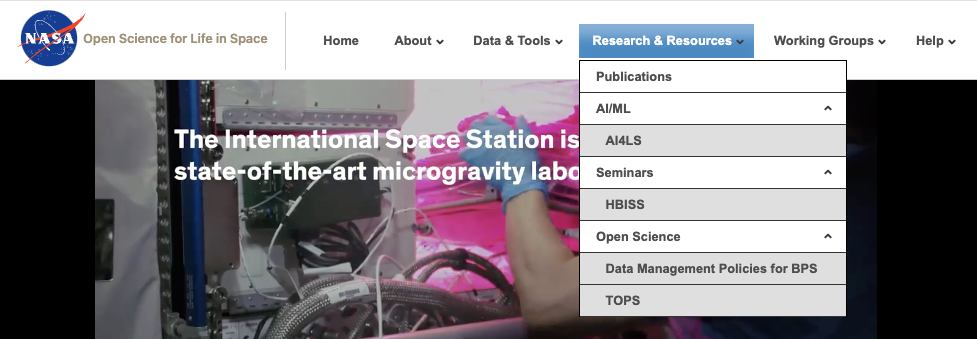
Publications: This page contains links to literature related to the Open Science Repository, a central hub for NASA’s open science publications. It includes journal articles, reports, and other scientific documents that have been made publicly available.
AI/ML: The “AI/ML” drop-down menu offers a link to the “AI4LS” (Artificial Intelligence for Life in Space Working Group) page. This working group brings together experts from NASA, academia, and industry to explore the potential of AI and machine learning for advancing life in space.
AI4LS: The AI4LS working group focuses on utilizing artificial intelligence (AI) and machine learning (ML) methods to analyze complex, heterogeneous, multi-modal biological datasets. ML approaches have shown promise for deriving meaningful patterns from these datasets and creating mathematical models to fit patterns and minimize errors. The group aims to build ML models to predict the physiological effects of spaceflight hazards using multi-modal biological and environmental data. Focus areas include causal inference, foundation models, and “self-driving” labs. Causal inference aims to elucidate causal relationships in complex biological data by combining invariance theory and ML methodology. Foundation models are trained on large, broad datasets and then refined on smaller datasets, which is relevant to space biology research due to limited sample size and restricted problem space. Self-driving labs are cutting-edge technology designed for space exploration. They employ automation and cloud-based systems to collect data points in a consistent and reproducible manner, leading to enhanced data acquisition and analysis.
Seminars: The analysis working groups regularly host spacebiology discussions and seminars.
The “HBISS Seminar Series” link leads to the Horizons in Biosciences & Informatics Seminar Series website. This internal NASA seminar series showcases cutting-edge research in the fields of biosciences and informatics, with presentations from leading scientists from around the world.
Open Science: The “Open Science” drop-down menu contains a link to the “Data Management Policies for BPS” page. This page summarizes the data management policies for the Biological and Physical Sciences (BPS) division of NASA’s Science Mission Directorate (SMD). It outlines the requirements for data management and sharing for BPS-funded research projects.
TOPS: The “TOPS” (Transform to Open Science) page provides an overview of the US White House’s Transform to Open Science initiative. This initiative aims to make publicly funded research more accessible and reproducible by requiring federal agencies to develop plans for transitioning to open science practices. The page also includes a link to enrole in the OS101 curriculum, which provides training on open science principles and best practices.
Data management policies: NASA seeks to transform science data management to increase research throughput and transparency. The Science Mission Directorate (SMD) has issued new policies, including the Scientific Information Policy for the Science Mission Directorate (SMD Policy Document SPD-41a). The Biological and Physical Sciences (BPS) division of SMD has further specified these policies in the BPS Scientific Data Management Policy (BPS-021). Guidance and aids on implementing these data management policies are available at various locations, including the Space Biology Open Science-Data Management Plan (OS-DMP) Template and Guidance, the ROSES Open Science and Data Management Plan, and the NASA Science Mission Directorate: Open-Source Science Guidance.
ROSES Open Science and Data Management Plan
NASA Science Mission Directorate: Open-Source Science Guidance
Working Groups
The Working Group dropdown menu in OSDR serve as a comprehensive resource for users to explore and engage with the organization’s Applied Working Groups (AWGs). Through this menu, users can access various pages that provide information related to the AWGs.
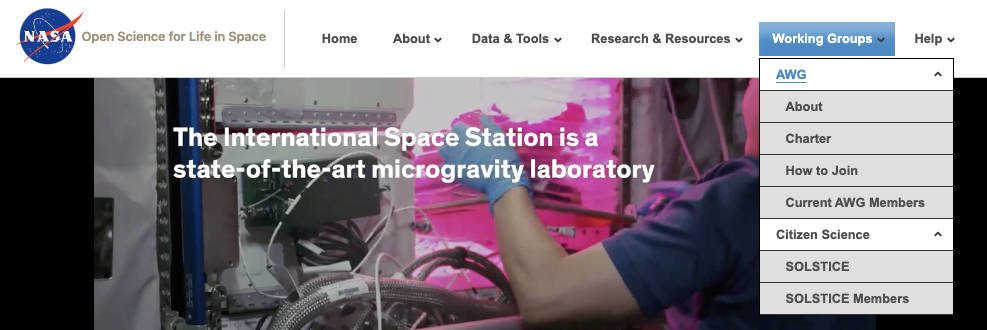
Come join one of our analysis working groups.
AWG(s): Analysis Working Group(s)
About: This page offers an overview of GeneLab’s AWGs, explaining their purpose, goals, and activities. It highlights how AWGs bring together experts, researchers, and community members to collaborate on specific scientific projects and initiatives.
Charter: Here, users can access the formal charter documents for each AWG. The charters outline the AWG’s mission, objectives, scope of work, and governance structure. They provide a framework for the AWG’s activities and ensure alignment with GeneLab’s overall strategic goals.
How to Join: This section guides how individuals can become members of an AWG. It outlines the eligibility criteria, application process, and selection procedures. Interested individuals can learn about the requirements and steps involved in joining an AWG.
Current AWG Members: This page lists the current members of each AWG. It includes the names, affiliations, and brief bios of the individuals involved. Users can explore the expertise and backgrounds of the AWG members, providing insights into the diversity and strength of GeneLab’s collaborative network.
Citizen science:
SOLSTICE Project Goals: Under the citizen science dropdown menu, users can find a description of the SOLSTICE project goals. SOLSTICE (Space Open Life Science Team for International Collaborative Exploration) is a citizen science project that engages the public in scientific research. This page outlines the project’s objectives, research questions, and anticipated outcomes.
SOLSTICE Members and Affiliations: This page lists the SOLSTICE members and their affiliations. Similar to the AWG members page, it provides information on the individuals involved in the SOLSTICE project, showcasing the diverse backgrounds and expertise of the participants.
Help
Open Science Data Repository (OSDR) offers a comprehensive collection of resources to assist users with various inquiries, policies, learning materials, and communication channels.

Feel free to contact us.
Frequently Asked Questions (FAQs): A dedicated FAQ section addresses common queries related to OSDR’s services, data submission process, accessibility, and account management. The FAQs are organized into categories for easy navigation and quick reference. Regular updates ensure that the information provided stays current and relevant.
Terms & Conditions: OSDR’s Terms & Conditions outline the legal agreement between the platform and its users. Clear explanations of rights, responsibilities, and expectations for both parties are provided. Adherence to these terms is crucial for maintaining a respectful and ethical environment within the archive.
Tutorials: Step-by-step tutorials guide users through essential tasks such as data submission, metadata creation, and search functions. Visual aids, screenshots, and detailed instructions make the learning process intuitive and accessible. Tutorials are regularly updated to reflect any changes or improvements in OSDR platform.
Contact Information: Multiple communication channels are available for users to reach OSDR staff including (the “GeneLab Slack” channel and Discourse “OSDR-space” are used by AWG’s for communication).