Space Mineral Atlas · NASA OSDR & LSDA Reanalysis
Crop-specific mineral responses to spaceflight, discovery of a 1000-fold unit error in OSD-655, dietary supply sufficiency vs overload safety, and the NASA LSDA data access landscape.
Key findings and reproducibility benchmarks across the SpaceMineralAtlas pipeline.
OSD-745 lettuce (24) & OSD-655 Tokyo Bekana (36).
423 mineral & nutritional studies audited.
OSD-655 mislabelled mg/g vs true µg/g dry weight.
213 request-gated • 145 never submitted.
Protected by CI regression & synthetic data guards.
Curated data correction of five major macronutrient elements.
OSD-655 (Tokyo Bekana grown in Veg-04A/04B) labels five major macronutrient elements — calcium, potassium, magnesium, phosphorus, and sulfur — as mg/g dry weight in both its data files and its official archived data dictionary. The true values are µg/g dry weight.
| Macronutrient | Concentration | Implied Dry Mass % | Biological & Physical Assessment |
|---|---|---|---|
| Potassium (K) | 29,430 mg/g | 2,943.0% | Physically Impossible (>100%) |
| Calcium (Ca) | 15,820 mg/g | 1,582.0% | Physically Impossible (>100%) |
| Sulfur (S) | 8,950 mg/g | 895.0% | Physically Impossible (>100%) |
| Phosphorus (P) | 6,840 mg/g | 684.0% | Physically Impossible (>100%) |
| Magnesium (Mg) | 3,110 mg/g | 311.0% | Physically Impossible (>100%) |
Stated units in OSD-655 imply plant tissues are composed of 2,943% potassium by dry mass, exceeding total physical sample mass by nearly 30-fold.
Any analysis pooling OSD-655 with OSD-745 or other elemental datasets without correcting this defect is wrong by a factor of 1000 on five of twelve elements. A full curation report with provenance has been deposited for the OSDR curation team: View OSDR Curation Report →
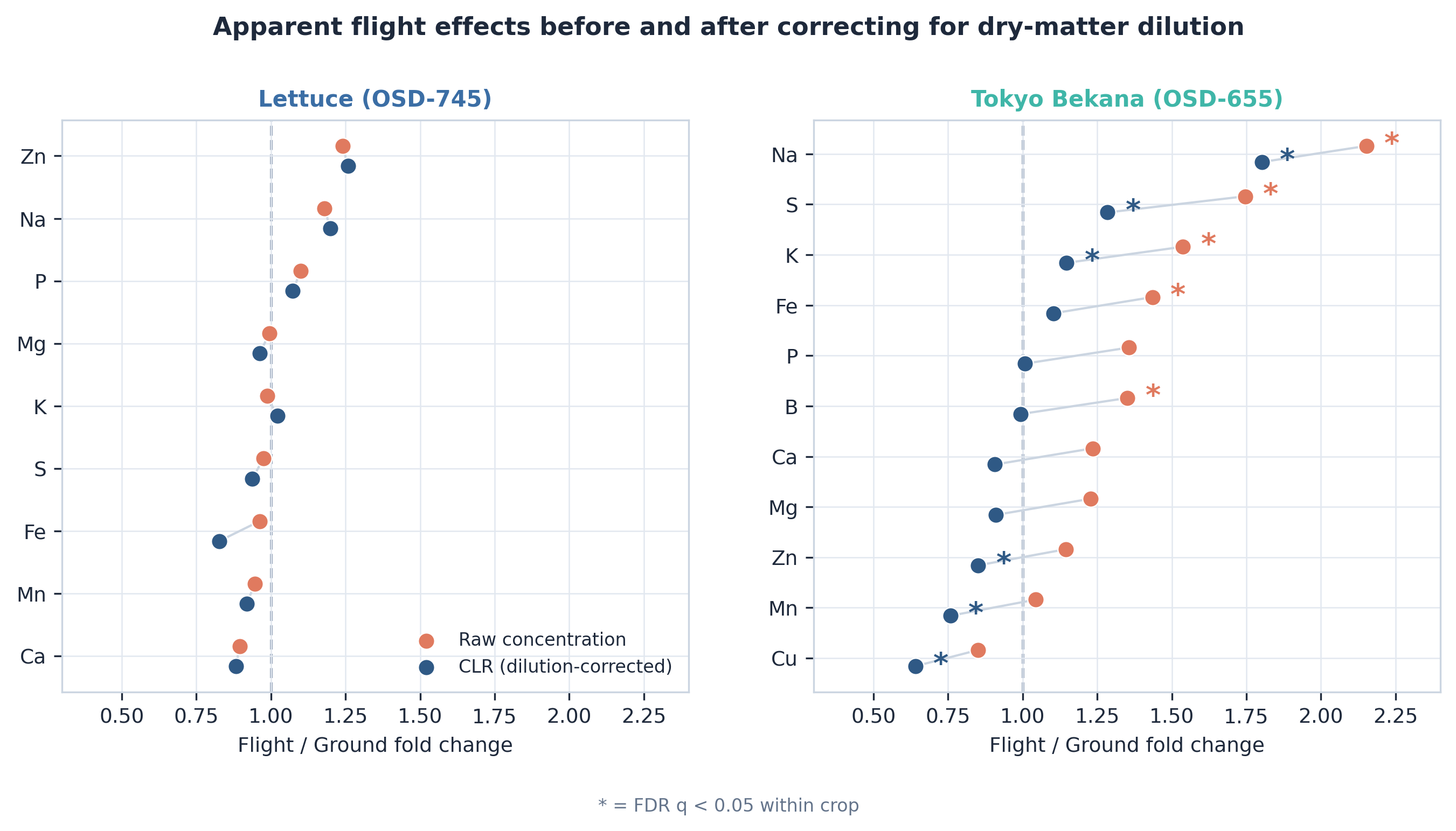
Apparent calcium and iron increases are dry-matter dilution artefacts.
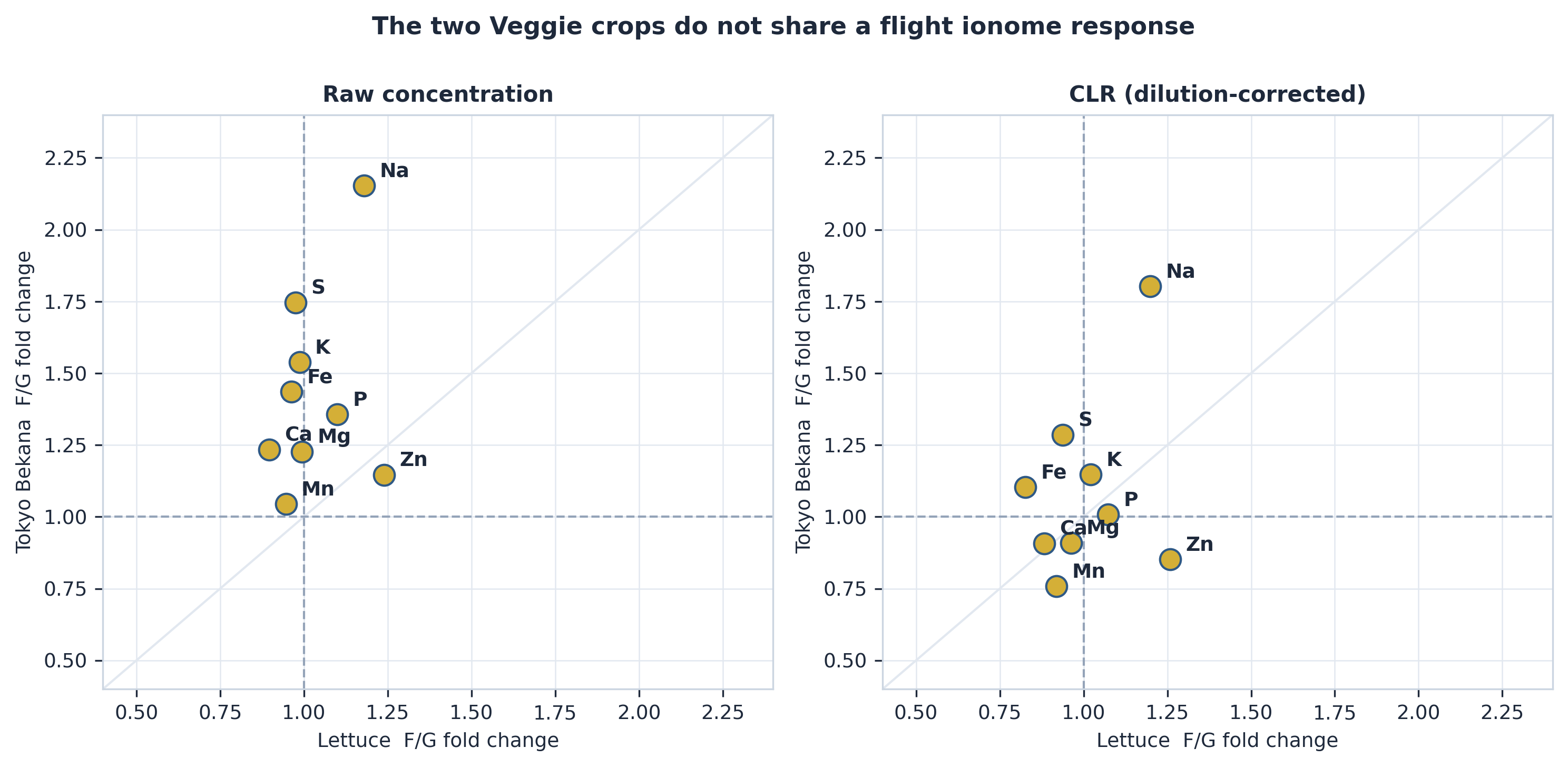
Raw elemental concentrations are compositional: if flight tissue shifts in dry-matter composition, all elements shift together even if specific ion uptake is unchanged. Correcting for dry-matter dilution using a Centred Log-Ratio (CLR) transform reveals that apparent calcium and iron increases are dilution artefacts.
| Element | Raw Fold Change | Raw p (FDR) | CLR Fold Change | CLR p (FDR) | Biological Status After CLR Correction |
|---|
Lettuce shows zero elements significantly altered by spaceflight on either raw concentration or CLR scale. Tokyo Bekana displays significant CLR increases in potassium (+15%), sodium (+80%), and sulfur (+28%), while copper, manganese, and zinc exhibit relative decreases. Apparent calcium and iron accumulations do not survive correction.
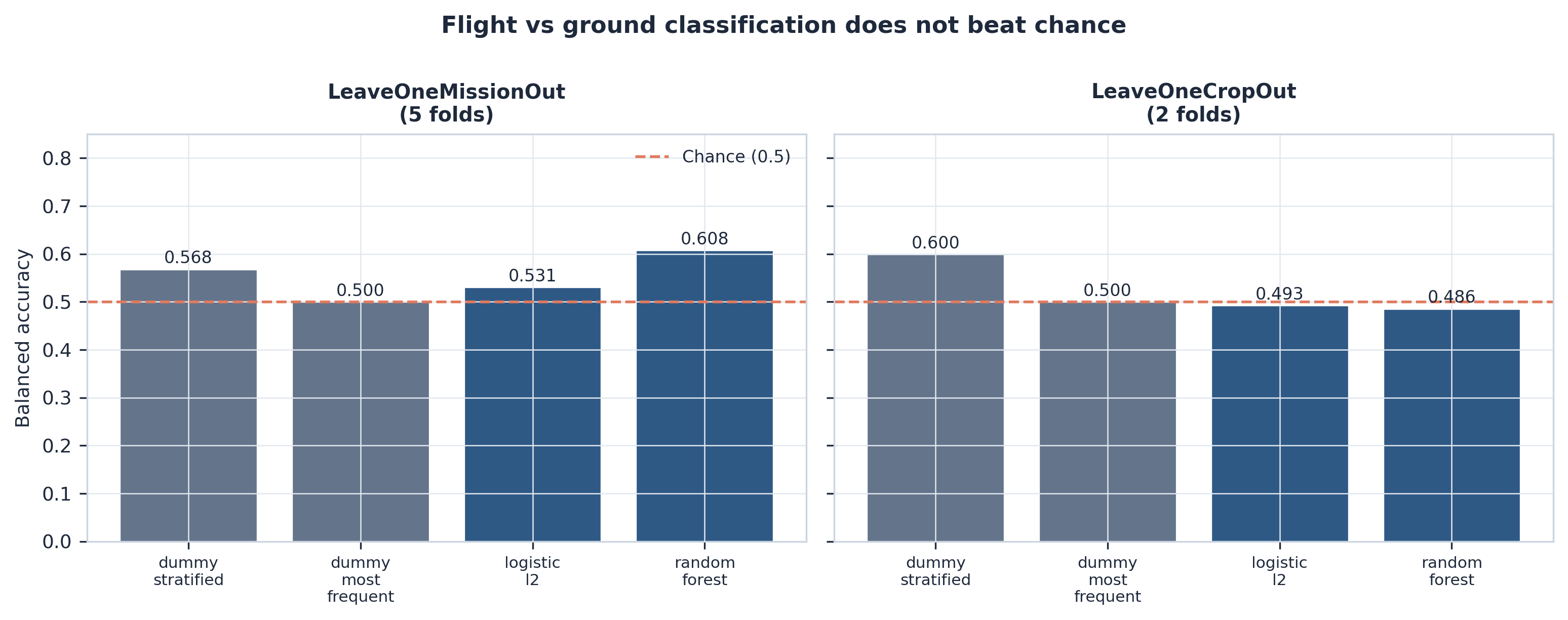
Cross-crop validation reveals the absence of a universal microgravity ionome response.
5 folds partitioning VEG-01A, VEG-01B, VEG-03A, VEG-04A, VEG-04B.
+0.040 Margin over chance (0.568)
Modest signal within mission cohorts, tracking environmental differences.
Train on Lettuce → Test on Tokyo Bekana (and vice versa).
-0.113 Below chance (0.600)
Below chance performance: Confirms no shared signature transfers between crops.
Permutation importance confirms that only Potassium, Sodium, and Sulfur contribute positive predictive signal — matching the exact three elements that survived CLR compositional correction.
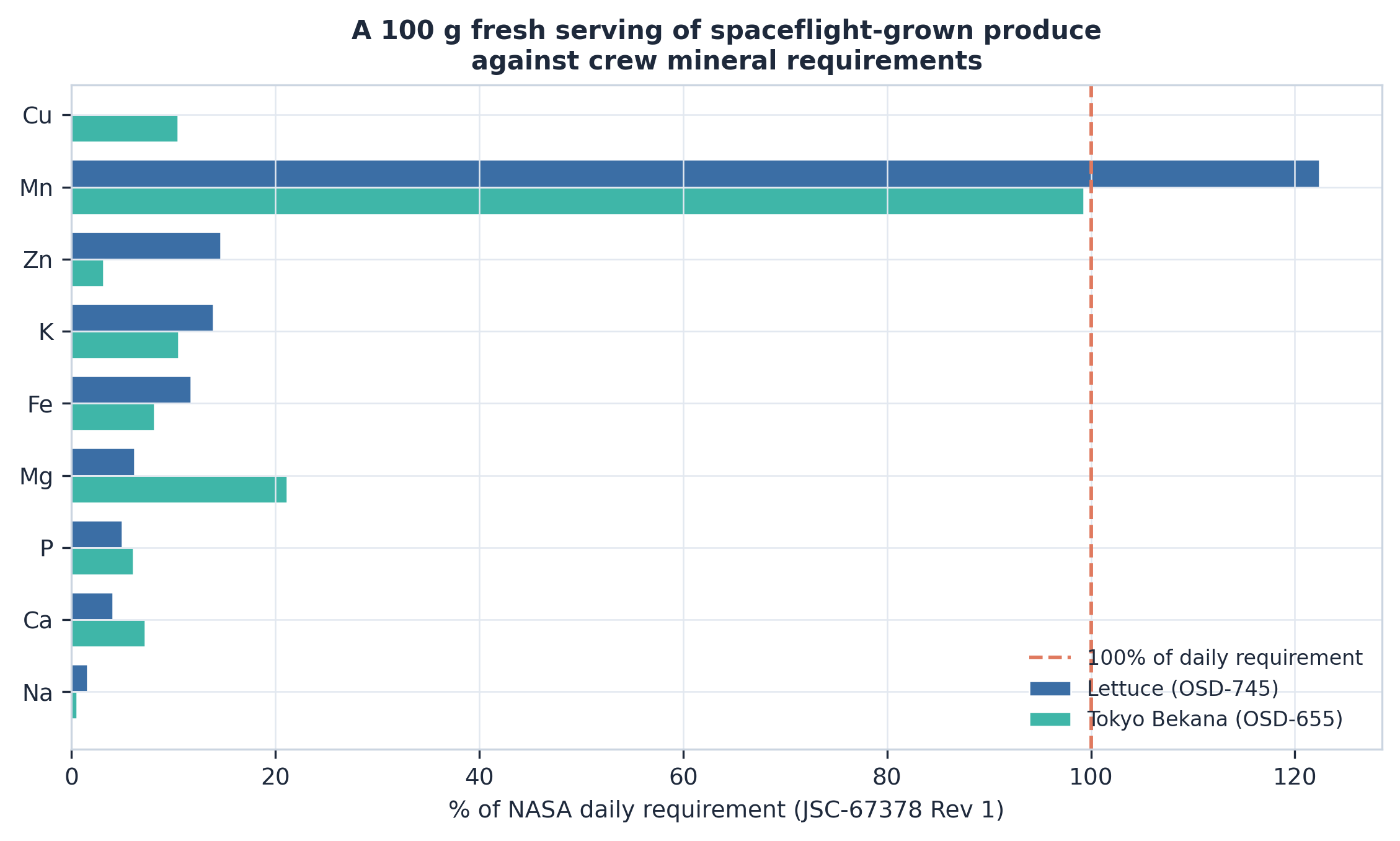
Real-time nutritional modeling against NASA JSC-67378 Rev 1 astronaut dietary standards.
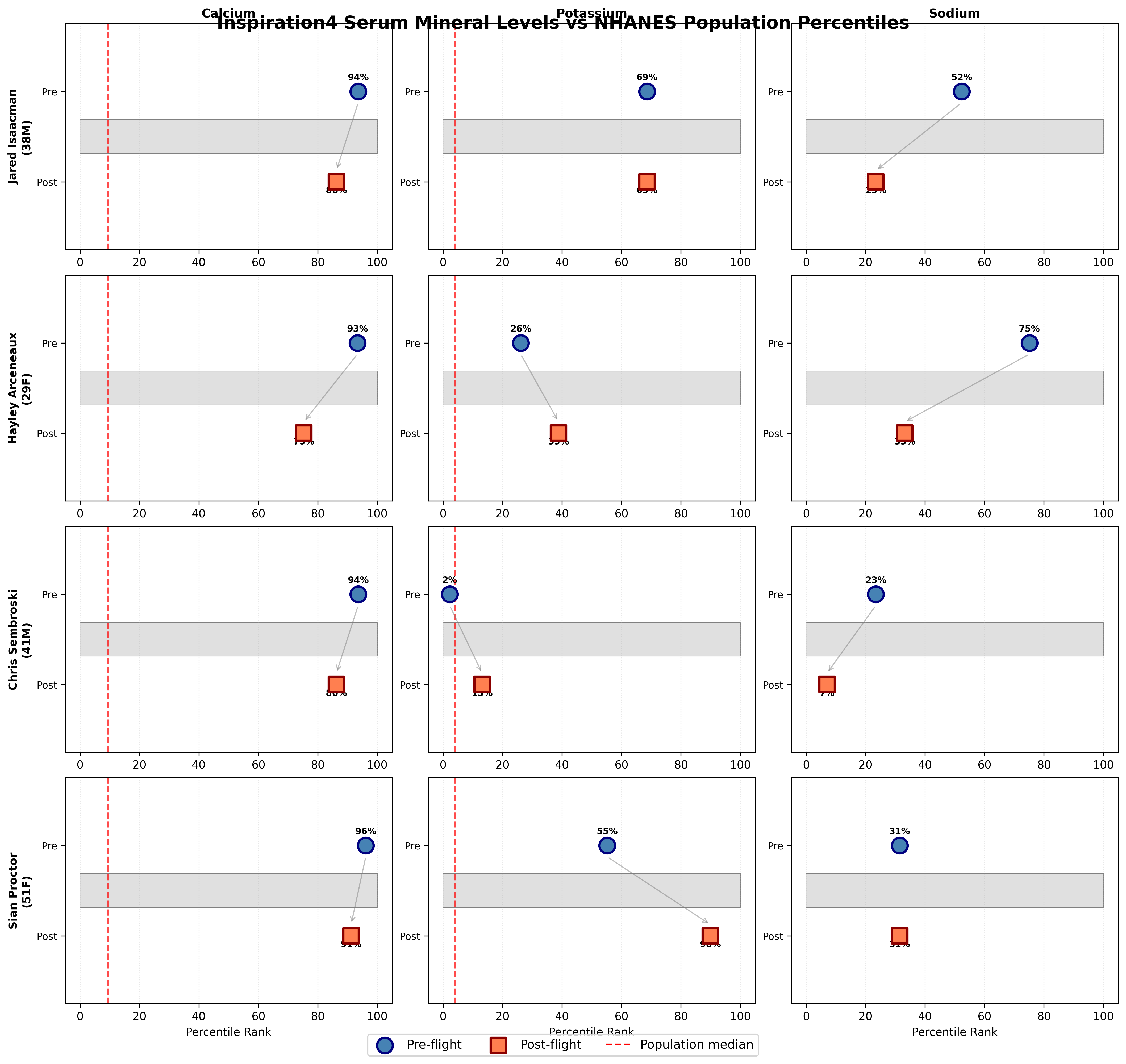
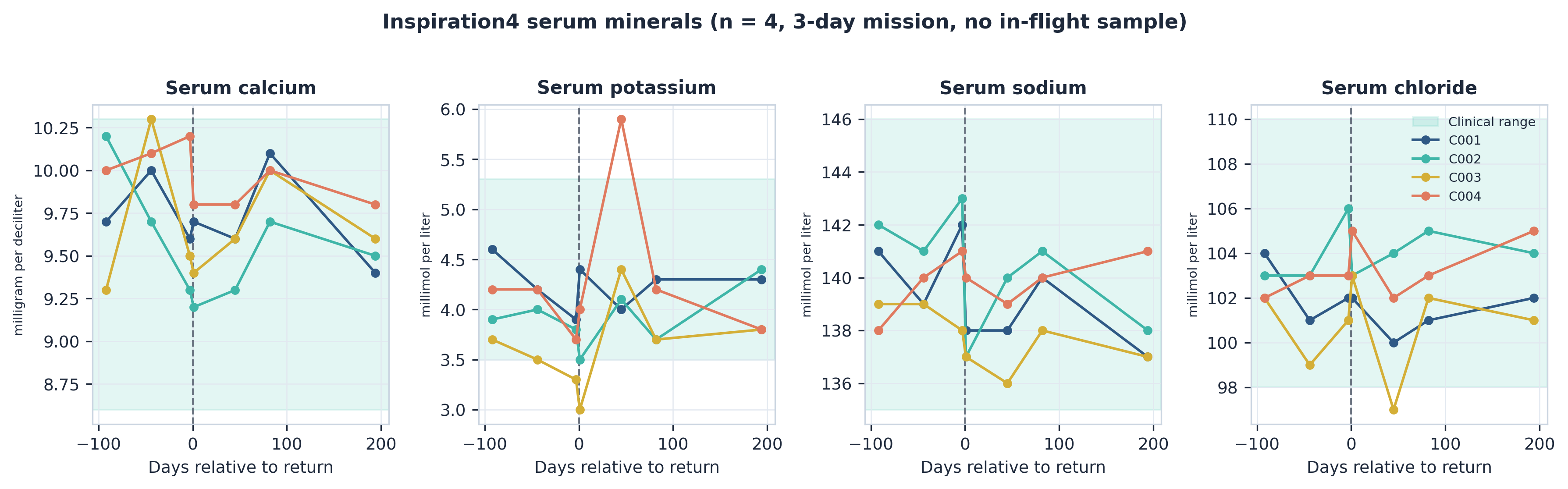
Longitudinal serum chemistry benchmarked against age- and sex-stratified US population percentiles.
4 subjects, a 3-day mission duration, and 0 in-flight biosamples. These trajectories describe clinical observations but cannot establish causal microgravity mechanisms without long-duration in-flight sampling.
Complete harmonised elemental ICP-OES measurements across OSD-745 and OSD-655 (µg/g dry weight).
| Sample ID | Crop | Mission | Condition | K (µg/g) | Ca (µg/g) | Mg (µg/g) | Fe (µg/g) | Mn (µg/g) | Na (µg/g) |
|---|
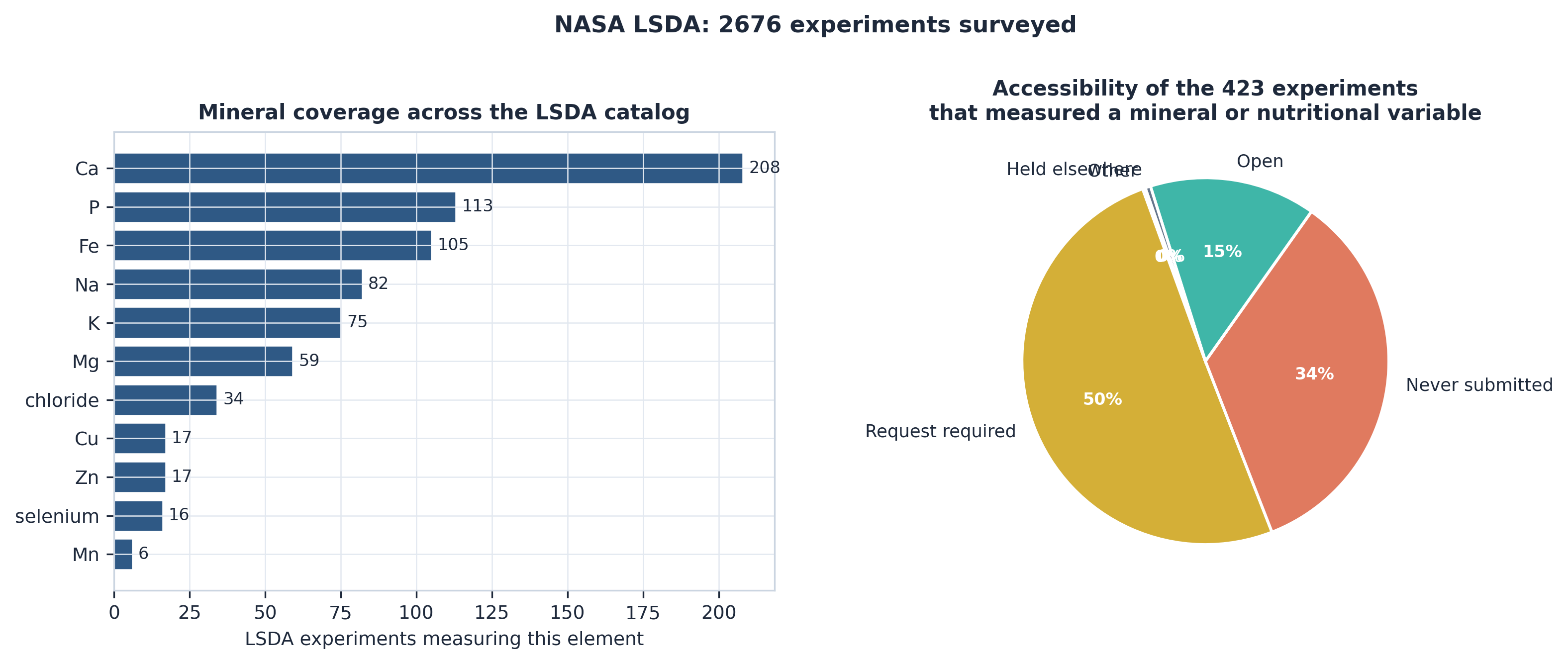
Audit of 2,676 LSDA experiments categorised by accessibility tiers.
Direct download without gating.
Institutional IRB / Form approval needed.
Completed studies without archived data.
The premier dataset for linking spaceflight diet directly to crew serum mineral dynamics — 27 astronauts across ~165-day missions with paired in-flight dietary intake and serum chemistry — is request-gated. A complete, turnkey LSDA data request application has been prepared in the repository: Explore LSDA Request Package →
| ID | Study Title | Principal Investigator | Subject / Species | Access Status |
|---|
Automated verification, zero synthetic data guarantee, and dataset repositories.
Automated CI tests fail the build if numpy.random, synthetic data generation, or unvalidated fallbacks are introduced.
All 179 statistics in the manuscript are injected directly from analysis JSON outputs via LaTeX macros, eliminating manual typing errors.
@article{Barker2026_SpaceMineralAtlas,
author = {Barker, Richard},
title = {SpaceMineralAtlas: Crop-Specific Mineral Responses to Spaceflight, a Unit-Labelling Defect in OSD-655, and a Survey of Mineral and Dietary Data Availability Across the NASA Life Sciences Data Archive},
year = {2026},
publisher = {GitHub / Zenodo},
url = {https://github.com/dr-richard-barker/SpaceMineralAtlas}
}