TIC-TOC · ISS National Lab · SpaceX CRS-22

Cotton grows more root — and mounts a calmer stress response — in spaceflight

Targeting Improved Cotton Through Orbital Cultivation: root architecture and the root/shoot transcriptome of wild-type and AVP1-overexpressing (AVP-OX) cotton aboard the ISS, analysed through a fully reproducible pipeline.

The finding

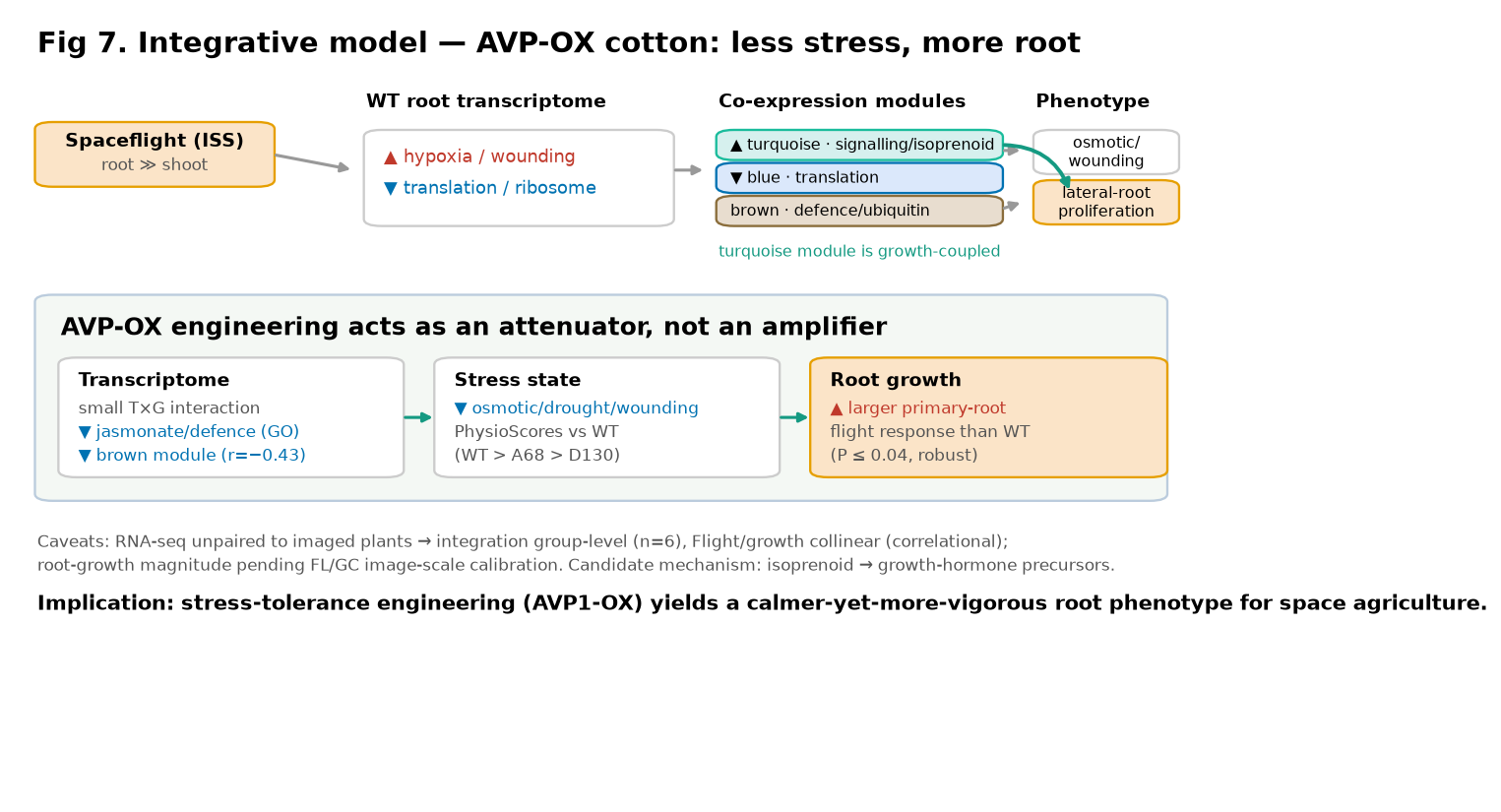
Against a shared, strongly tissue-specific spaceflight response (a canonical hypoxia/wounding induction with translational suppression in wild-type roots), the AVP-OX engineering acts as an attenuator, not an amplifier of the defence/stress programme — while the engineered lines sustain a larger primary-root spaceflight response than wild type. In short: AVP-OX cotton appears to experience microgravity as less stressful while growing more root — a favourable trait for space agriculture.

Supported by four independent analyses:

Morphometrics
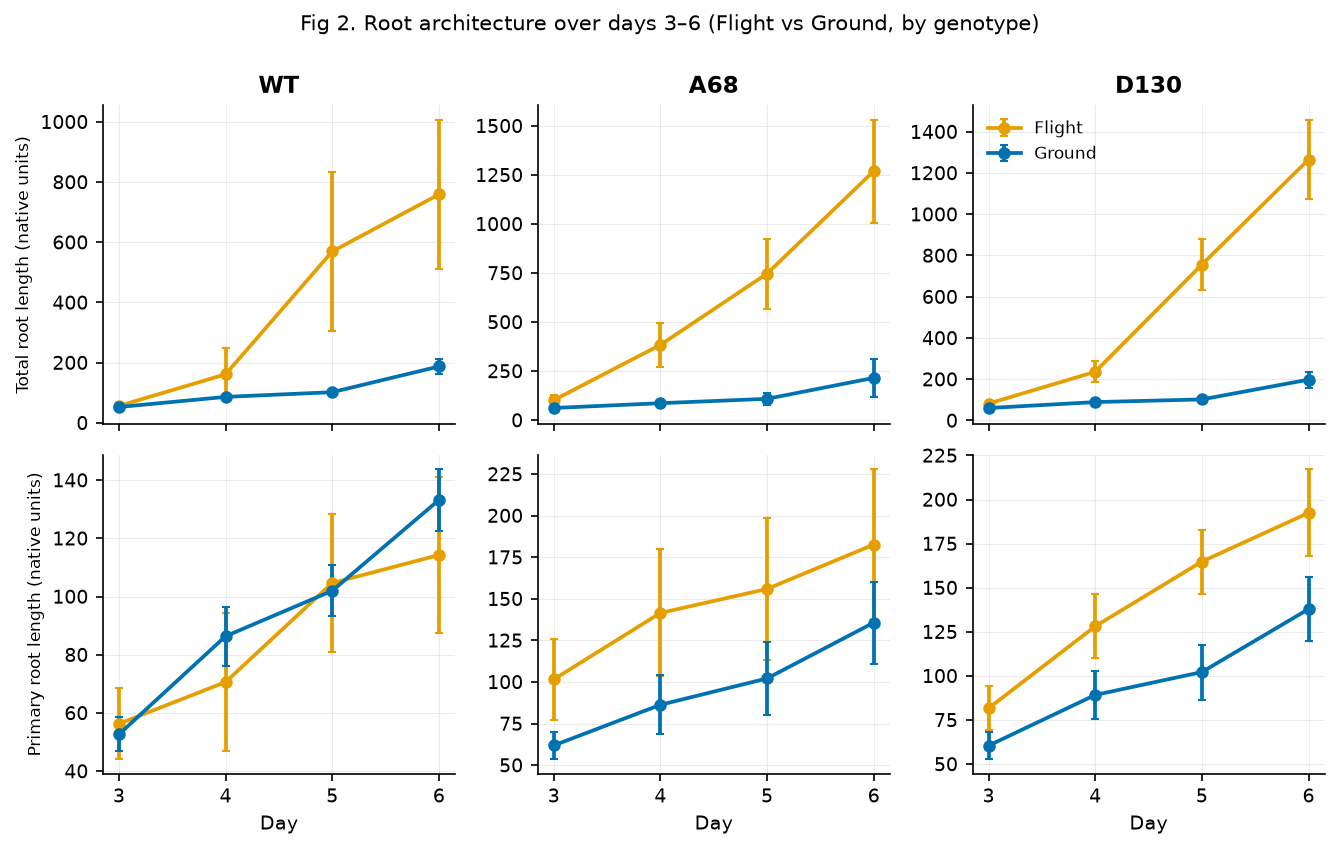
AVP-OX larger primary-root flight response (P ≤ 0.04)
GO / KEGG
Jasmonate/wounding defence suppressed in AVP-OX
PhysioSpace
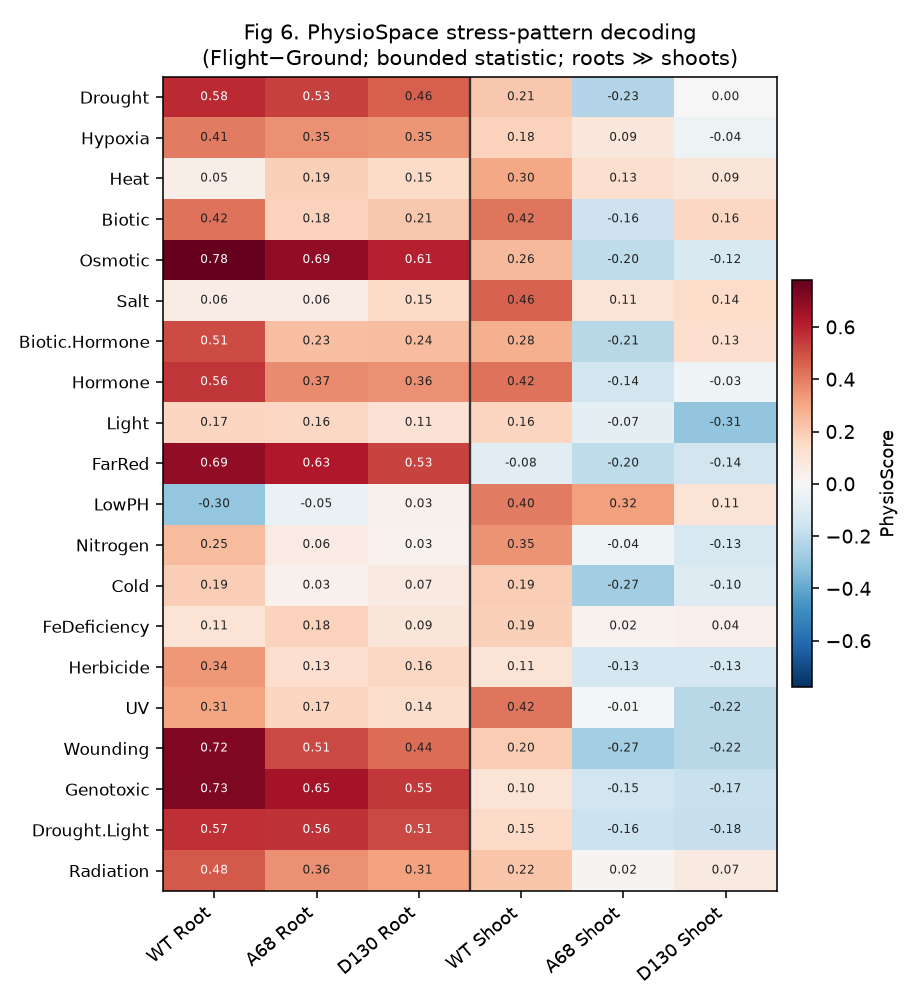
Lower osmotic/wounding stress scores vs WT
WGCNA
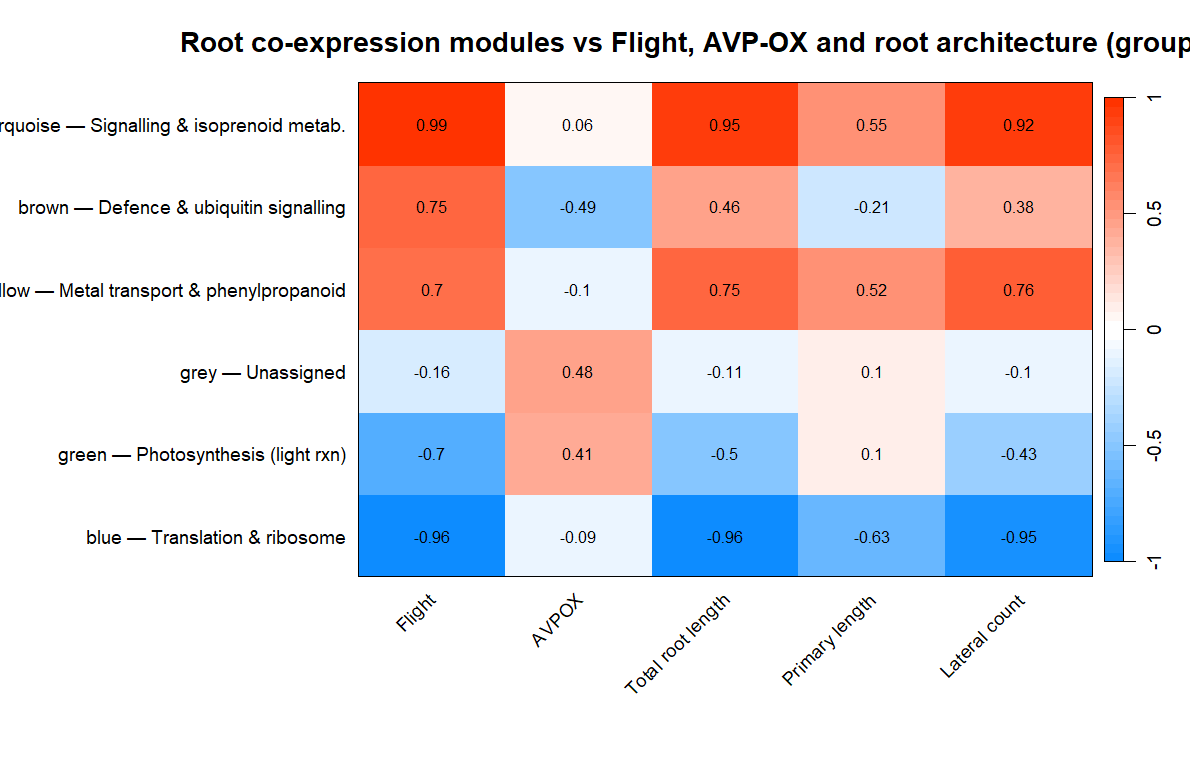
Defence module down in AVP-OX; growth-coupled module up

Figures

Experimental design and analysis workflow
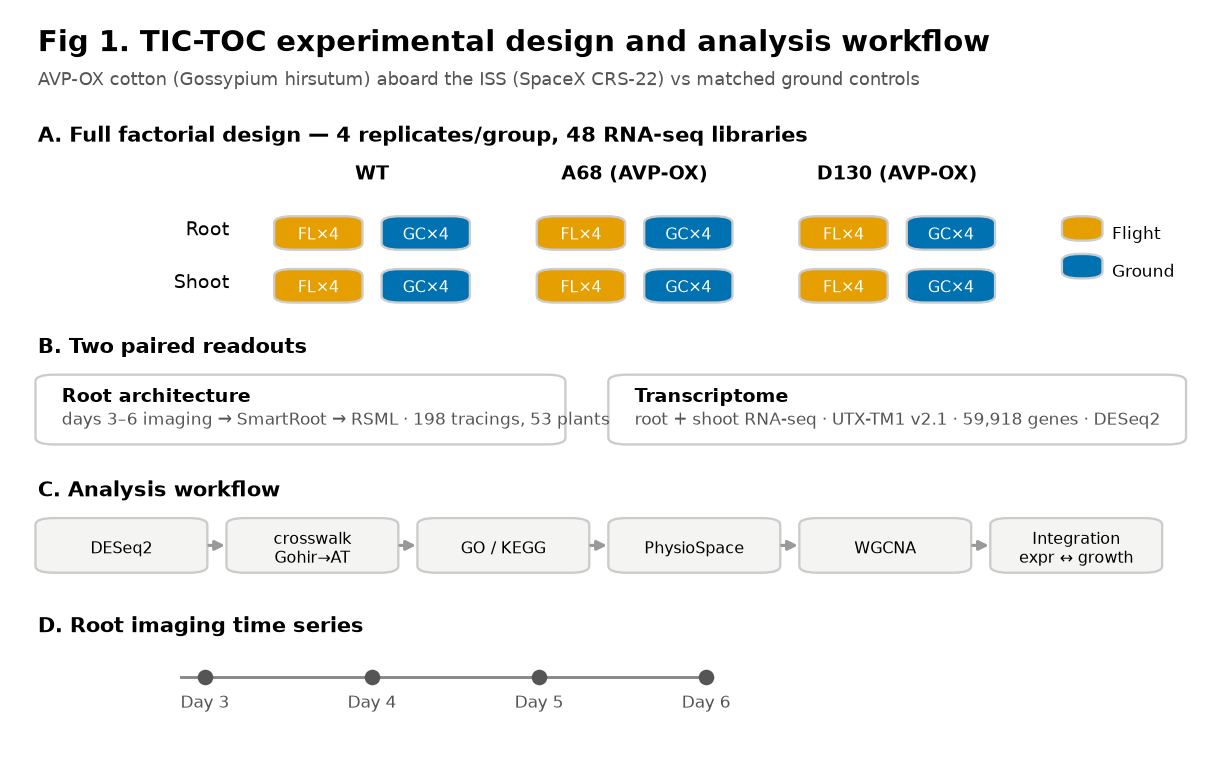
Fig 1. Full factorial design (Treatment × Genotype × Tissue, 48 RNA-seq libraries), paired root imaging (days 3–6 → RSML), and the reproducible analysis workflow.
Root architecture over days 3-6
Fig 2. Root growth days 3–6, Flight vs Ground by genotype. Total length diverges (lateral-driven); primary-root effect is the robust AVP-OX signal.
Differential expression counts per contrast
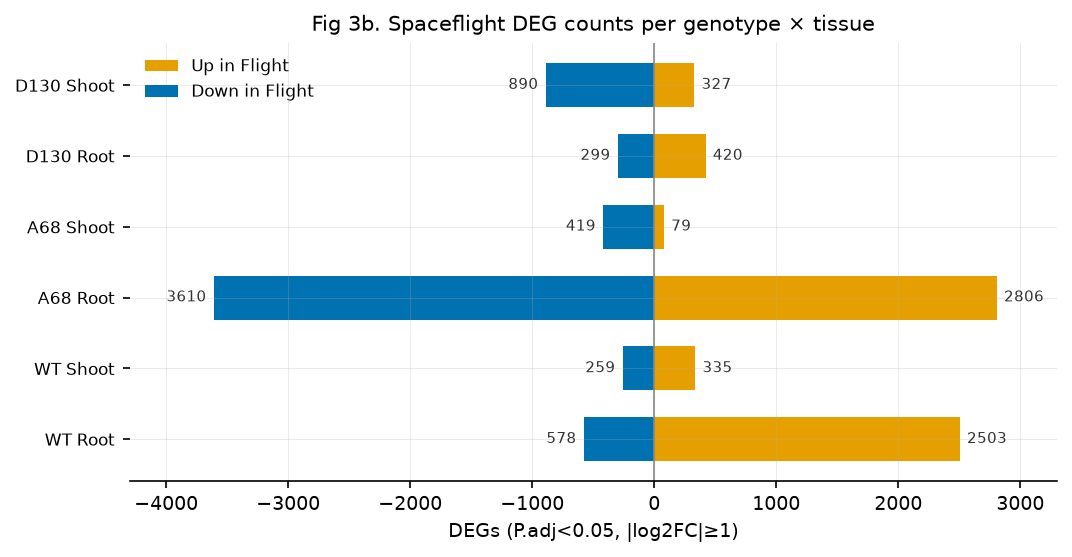
Fig 3. Spaceflight DEGs per genotype × tissue — root ≫ shoot; AVP-OX interaction contrasts down-biased.
WGCNA module-trait heatmap
Fig 4. Root co-expression modules (named by GO) vs Flight, AVP-OX and root architecture. Turquoise (signalling/isoprenoid) tracks growth; brown (defence) is down in AVP-OX.
GO enrichment dotplot
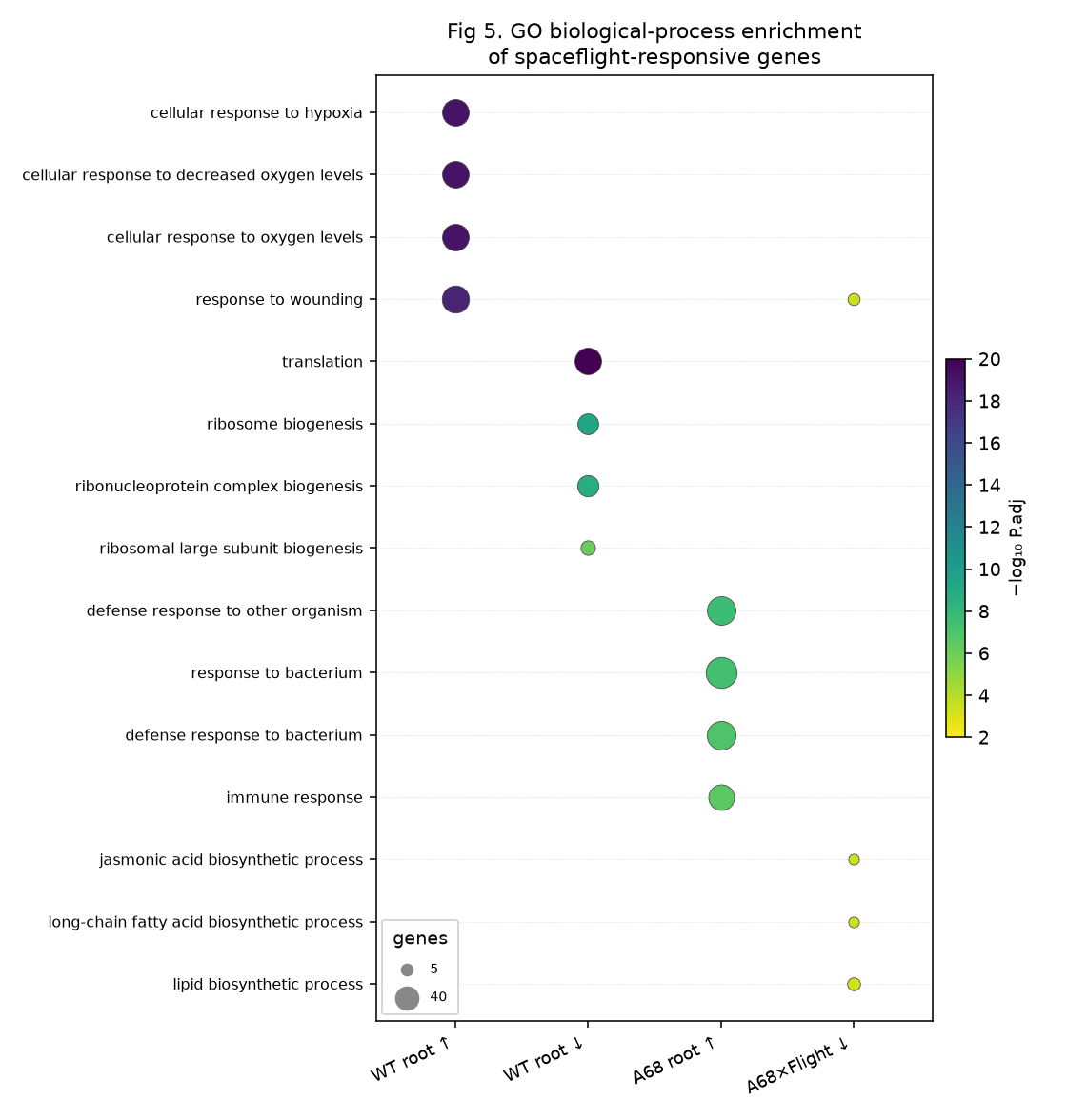
Fig 5. GO enrichment: WT roots induce hypoxia/wounding and suppress translation; A68 shifts to defence; the AVP-OX interaction down-regulates jasmonate biosynthesis.
PhysioSpace stress score heatmap
Fig 6. PhysioSpace decoding: spaceflight roots (left) activate a broad osmotic/drought/wounding stress signature; AVP-OX roots score lower than WT; shoots (right) are muted.
Autoencoder expression-program atlas
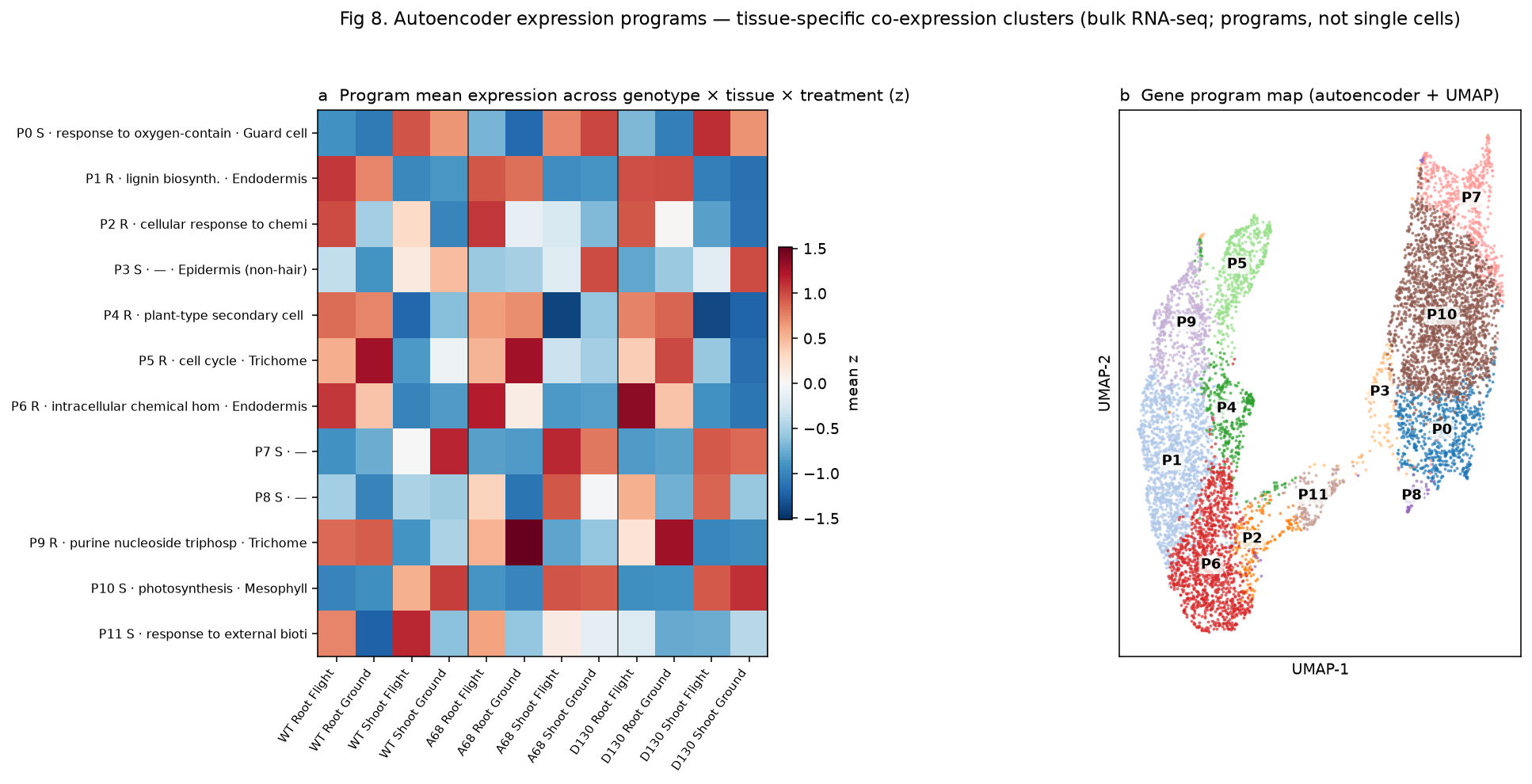
Fig 8. Deep-learning expression-program atlas — an autoencoder clusters genes into tissue-specific co-expression programs (bulk RNA-seq; programs, not single cells), annotated by GO function and Arabidopsis cell-type markers.
Program stress response WT vs AVP-OX
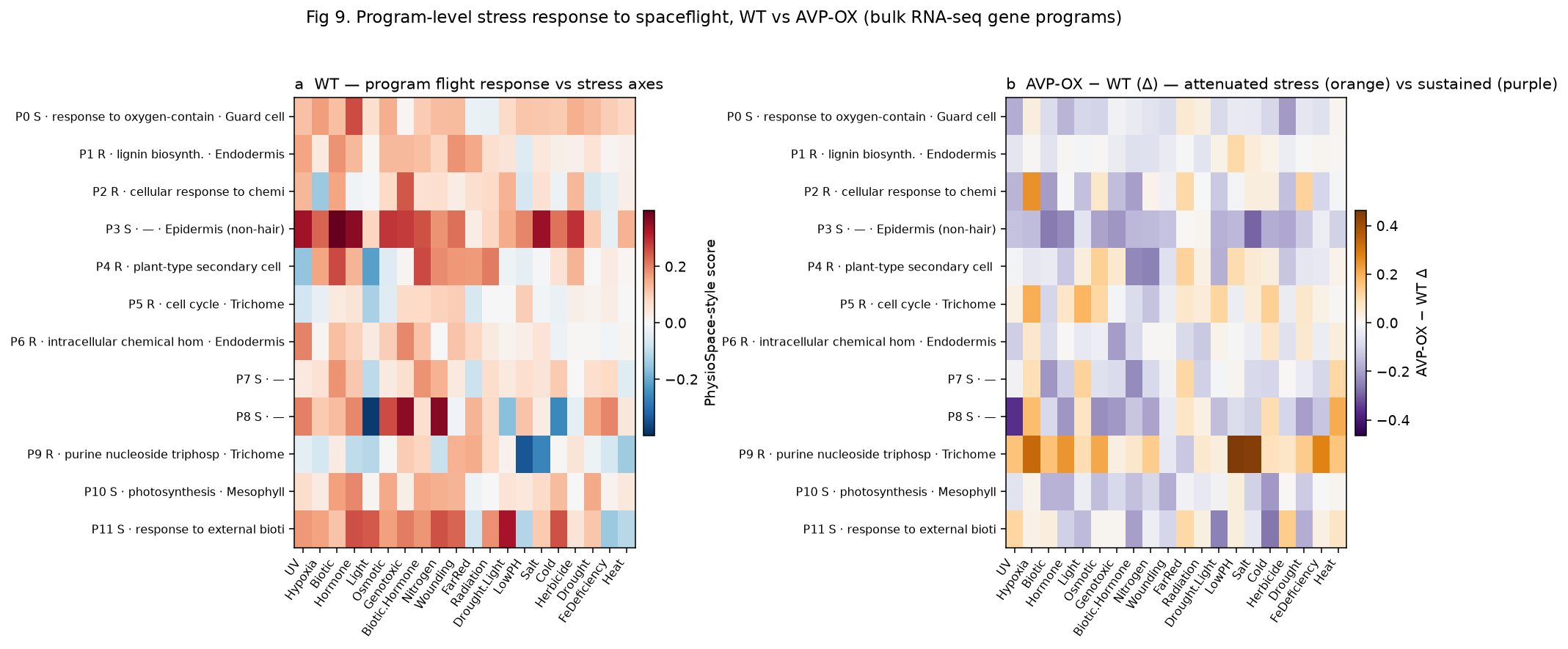
Fig 9. Program-level stress response to spaceflight, WT vs AVP-OX. The engineered lines attenuate the stress/defence programs (orange) while sustaining growth/metabolic programs (purple) — localising the whole-transcriptome effect to specific functional programs.
Integrative model
Fig 7. Integrative model: tissue-specific stress response, AVP-OX as an attenuator, and the growth-coupled module — less stress, more root.

Spaceflight DEGs (Flight vs Ground)

DESeq2, P.adj < 0.05, |log₂FC| ≥ 1 (ashr-shrunk). Root responds far more than shoot.

ContrastUpDown
WT · Root2503578
A68 (AVP-OX) · Root28063610
D130 (AVP-OX) · Root420299
WT · Shoot335259
A68 · Shoot79419
D130 · Shoot327890

Reproducible pipeline

Every result regenerates from committed scripts (R 4.6; versions in ENVIRONMENT.txt).

  1. deseq2/ — DESeq2 contrasts + factorial (V4) model
  2. crosswalk/ — Gohir → Arabidopsis ortholog map (CottonGen BLASTP)
  3. go_analysis/ — clusterProfiler GO / KEGG
  4. physiospace/ — PhysioSpace stress-pattern decoding
  5. wgcna/ — co-expression modules (GO-named)
  6. morphometrics/ — RSML trait extraction + mixed models
  7. integration/ — transcriptome ↔ root-architecture model

Honest limitations

  • The large total-length flight effect is lateral-root driven; absolute magnitude is pending Flight/Ground image-scale calibration. The primary-root AVP-OX result is robust to this.
  • RNA-seq libraries are not individually paired to imaged plants, so the expression ↔ architecture integration is group-level (n = 6) and correlational — pathways are consistent with driving growth, not proven causal.
  • Ortholog mapping is best-BLASTP-hit (approximate); single mission.

Data & code availability

Raw reads, count matrices, root images and RSML tracings: NASA OSDR/GeneLab (accession pending; released on publication). Analysis code and derived tables: this repository (data CC0-1.0; code MIT) and a forthcoming Zenodo archive. Grown in the ISS Veggie facility (custom Target Veggie Chambers); ISS National Laboratory (CASIS UA-2018-276) with support from the Target Corporation.