🌌 Executive Summary & Scientific Context

Future crewed lunar and Martian surface habitats, extravehicular activity (EVA) staging airlocks, and bioregenerative life-support systems (BLSS) will operate under NASA's reduced-pressure, oxygen-enriched Exploration Atmosphere: 56.54 kPa (8.2 psia) at 34% O₂ (normoxic oxygen partial pressure pO₂ = 19.22 kPa) and a staged pre-EVA setpoint of 70.33 kPa (10.2 psia) at 26.5% O₂ (pO₂ = 18.64 kPa).

The Fundamental Biophysical Asymmetry: By the Chapman–Enskog kinetic theory of gases, binary molecular diffusivity scales inversely with total pressure (D ∝ 1/P_total). Reducing cabin pressure to 56.54 kPa accelerates gas and water-vapor diffusion by 1.72× relative to ISS standard air (97 kPa), stripping the leaf boundary layer and driving acute evaporative demand. While 34% O₂ eliminates crew hypoxia, plants still experience intense physical barosensory stress that oxygen supplementation alone cannot cure.

Here, we integrate the TabPFN v2 tabular foundation model (Hollmann et al., Nature 637, 319–326, 2025) across a 12-dataset multi-omics compendium spanning 281 microarray hybridizations, 40,860 root-tip single nuclei, 326 whole-plant gas-exchange records, and factorial pressure × humidity LC-MS metabolomics to decouple total barometric pressure from oxygen partial pressure.

🔬 Six-Workpackage Systems Architecture

Workpackage 1
Forensic Metadata Audit & Organ Classifier
Deduplicated 18 shared arrays between GSE87867 and GSE87903. Coupled raw Affymetrix CEL headers with TabPFN v2 probabilistic auditing (AUC = 1.0000, Brier = 0.000002) to prove that 4 disputed 75 kPa samples (GSM2342806–809) are Shoots mislabeled as Roots in GEO, corrected 5 kPa root labels, and resolved replicate-A re-hybridizations across scanner batches (r = 0.9951–0.9964).
130 Unique Arrays • 22,746 Probesets • Table S1
Workpackage 2
TabPFN v2 Atmospheric Decoupling & Hub Networks
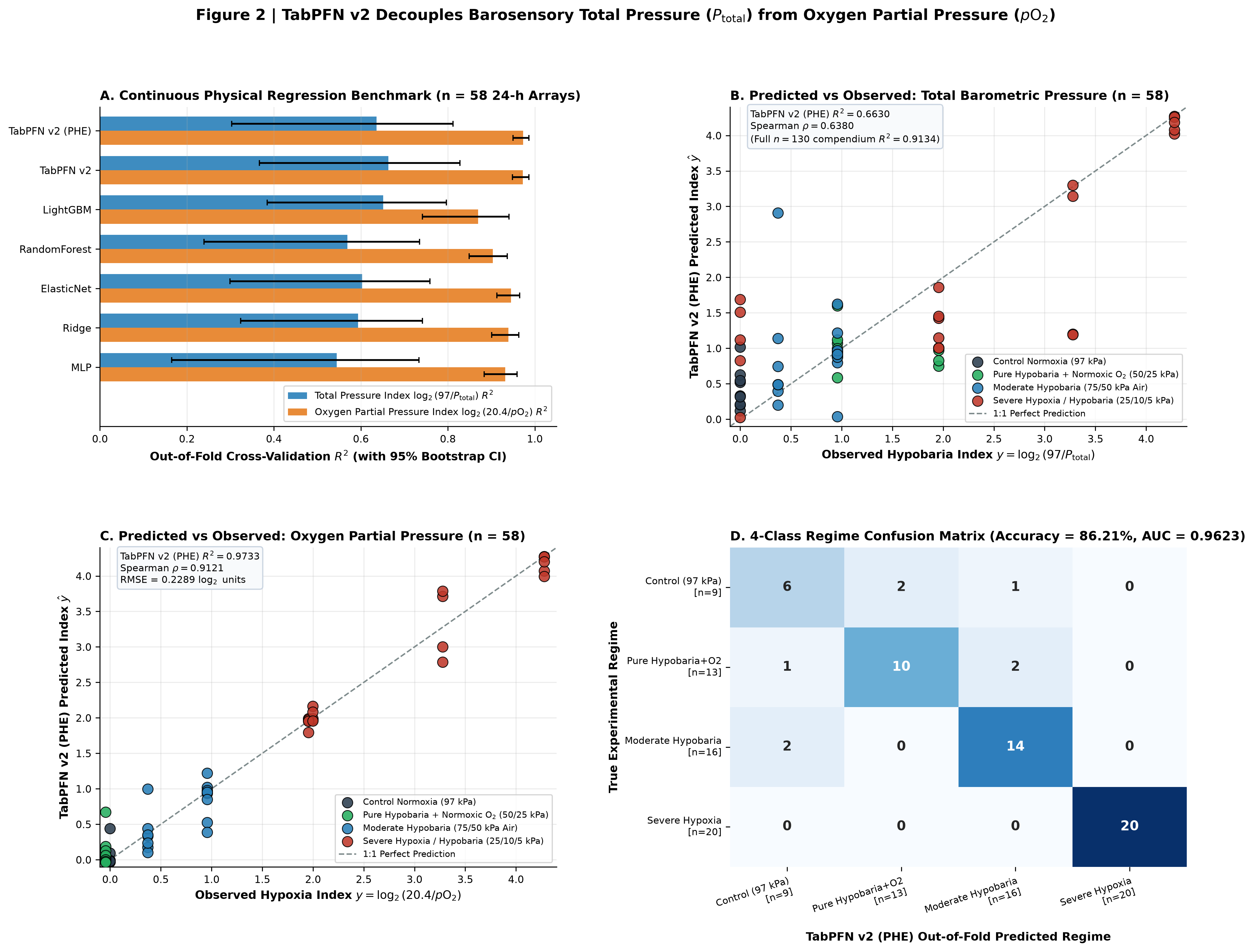
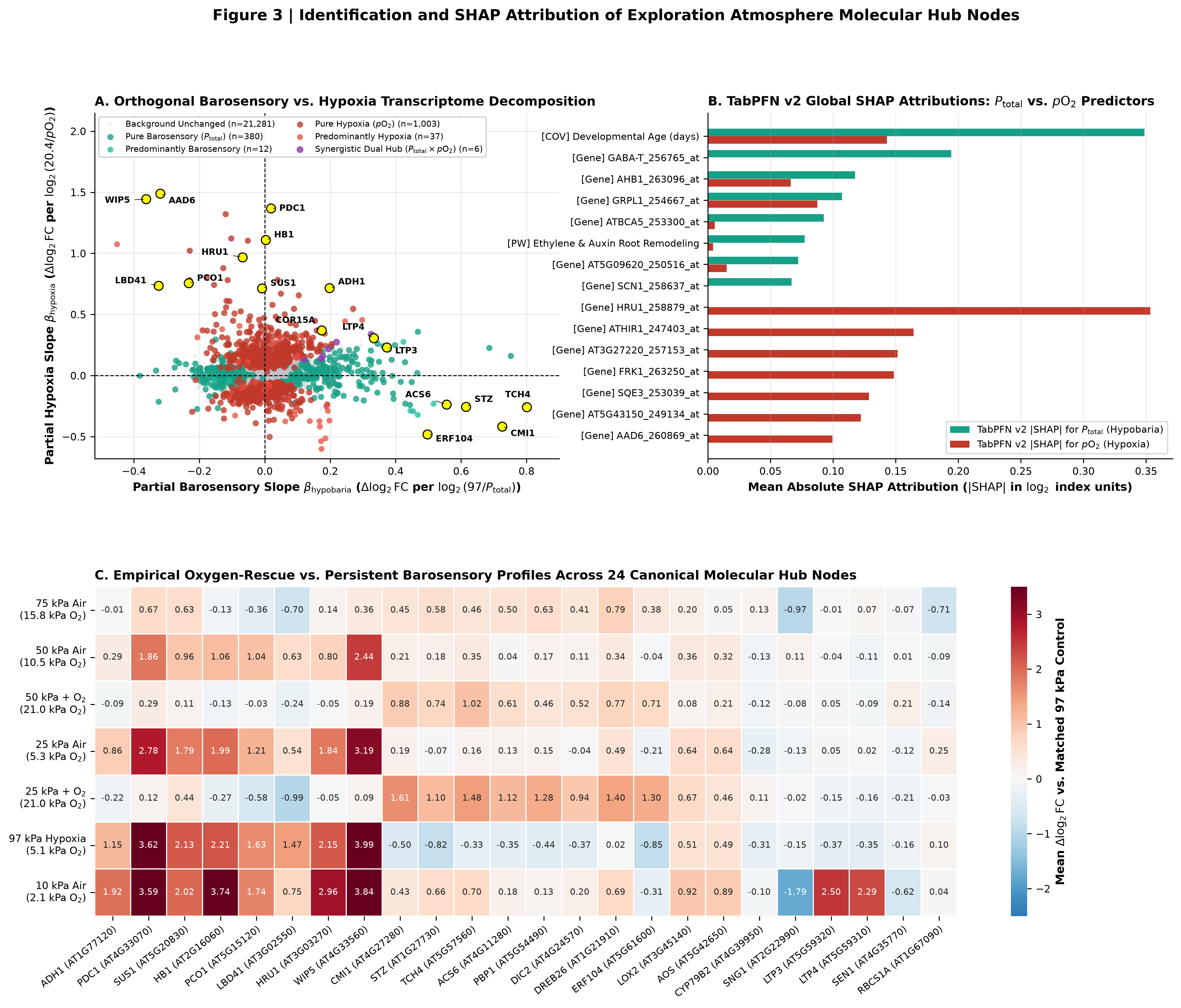
Benchmarked TabPFN v2 against LightGBM, Random Forest, ElasticNet, and deep MLP under condition-grouped cross-validation. TabPFN v2 (PHE) achieved R² = 0.9134 on continuous hypobaria regression and ROC-AUC = 0.9623 on 4-class regime classification. Orthogonal regression with limma moderation separated 1,003 Pure Hypoxia hubs from 380 Pure Barosensory hubs (CMI1, STZ, TCH4, LOX2, ACS6), 21 Additive Dual Hubs, and 12 Interaction Hubs.
R² = 0.9134 • 380 Barosensory Hubs • Tables S2A–S3
Workpackage 3
Cell-Type TRAP-seq & Single-Nucleus Mapping
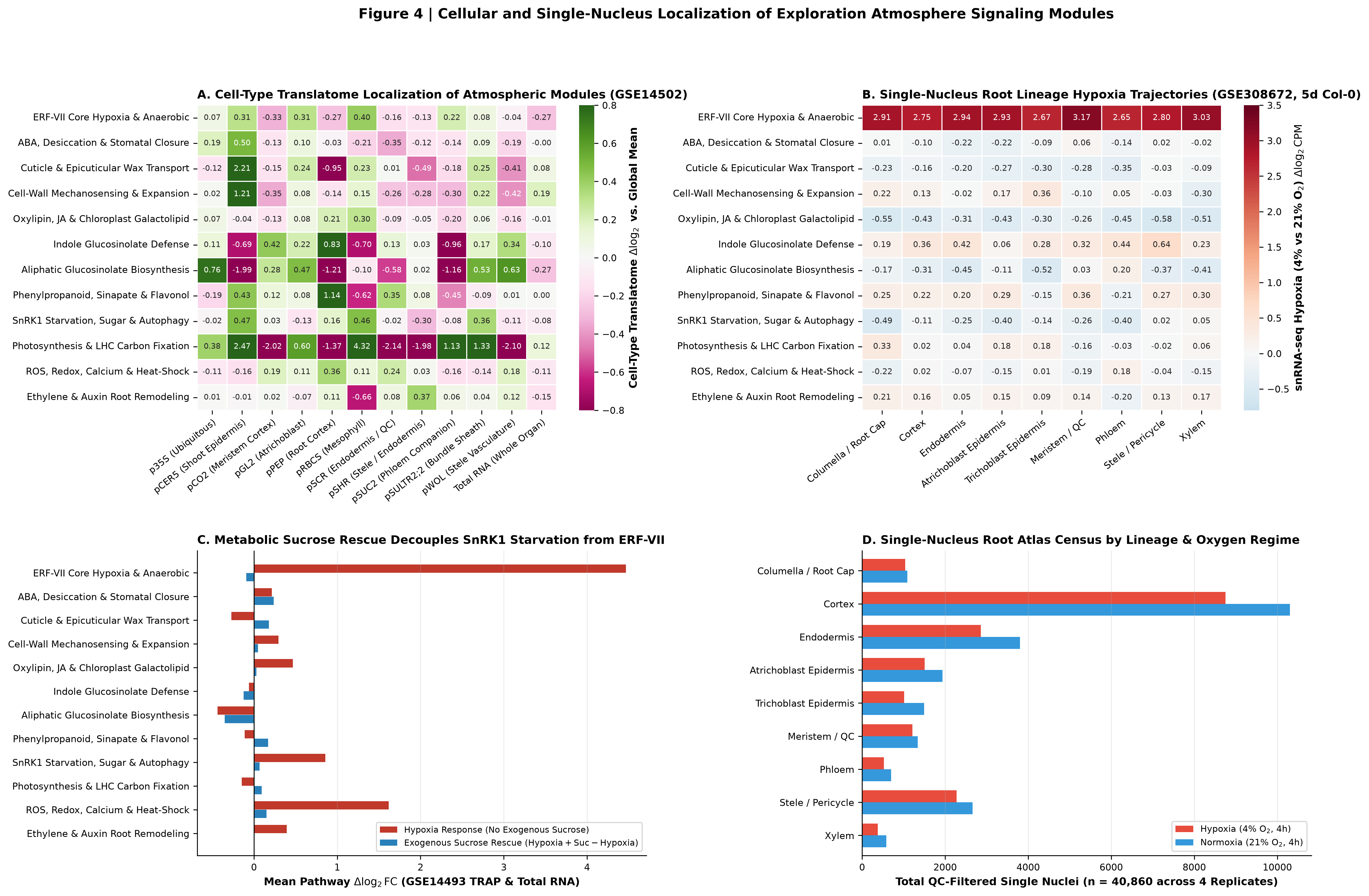
Mapped atmospheric modules across 19 cell-type TRAP-seq translatomes (GSE14493/14502) and 40,860 root-tip single nuclei (GSE308672). Demonstrated that hypoxia induces ERF-VII anaerobic modules across all 9 root lineages (+2.65 to +3.17 log2CPM), whereas barosensory wax, cuticle, and mechanosensing hubs localize specifically to pCER5 shoot epidermis (+2.21 and +1.21 log2).
19 Cell Types • 40,860 Single Nuclei • Tables S4A–B
Workpackage 4
Physiological & Metabolomic Phenotypic Bridge
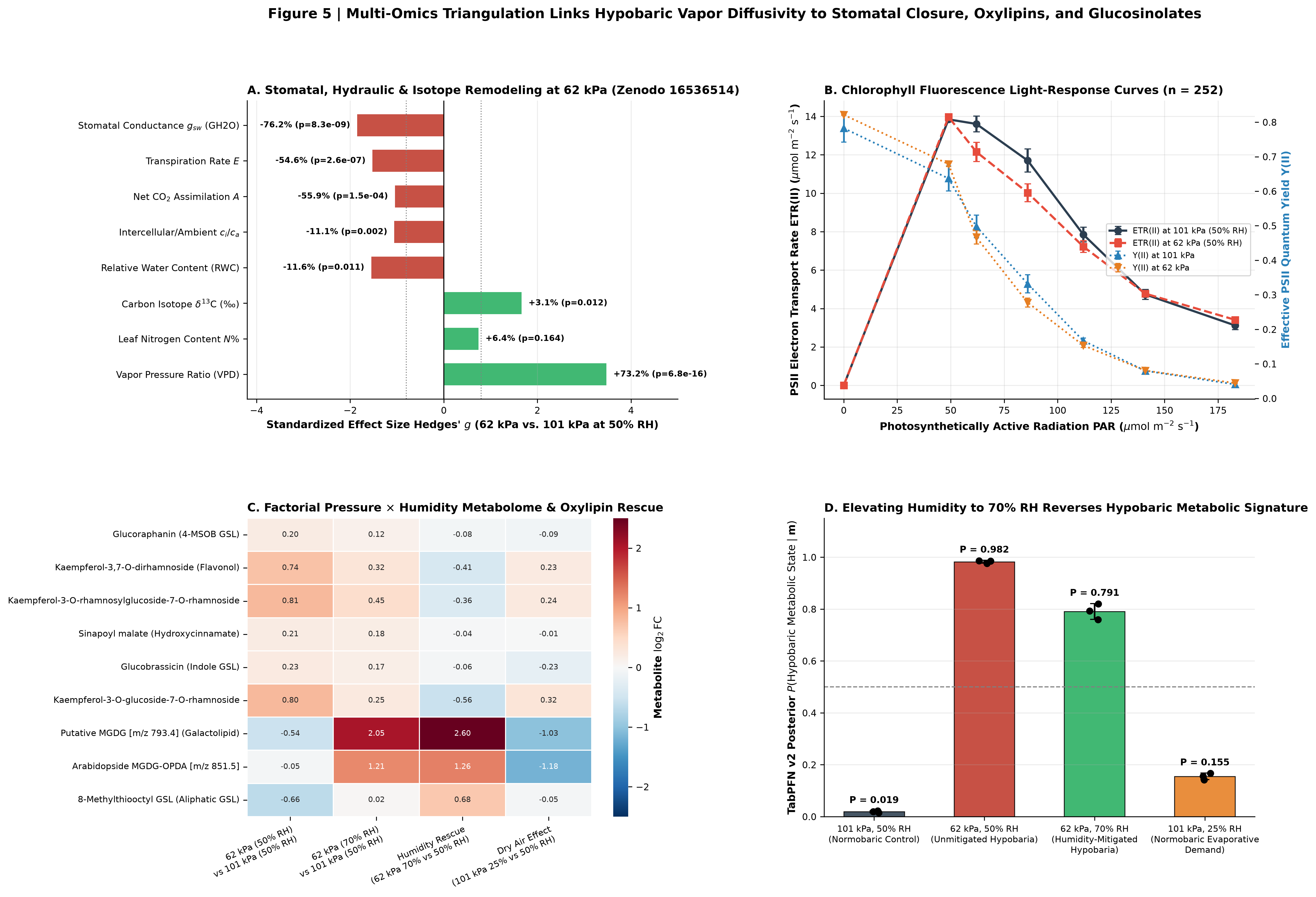
Triangulated Ecotron whole-plant gas exchange (ZENODO16536514) at 62 kPa vs 101 kPa, revealing a +73.23% vapor pressure ratio surge driving a -76.25% collapse in stomatal conductance (g_sw) and a -55.93% drop in CO₂ assimilation. Factorial pressure × humidity LC-MS metabolomics proved that 70% RH restores chloroplast oxylipin galactolipids (MGDG-OPDA) and reduces hypobaric state probability from 0.982 to 0.791.
326 Records • LC-MS Lipids/GSLs • Tables S5A–C
Workpackage 5
NASA Exploration Atmosphere Counterfactual Synthesis
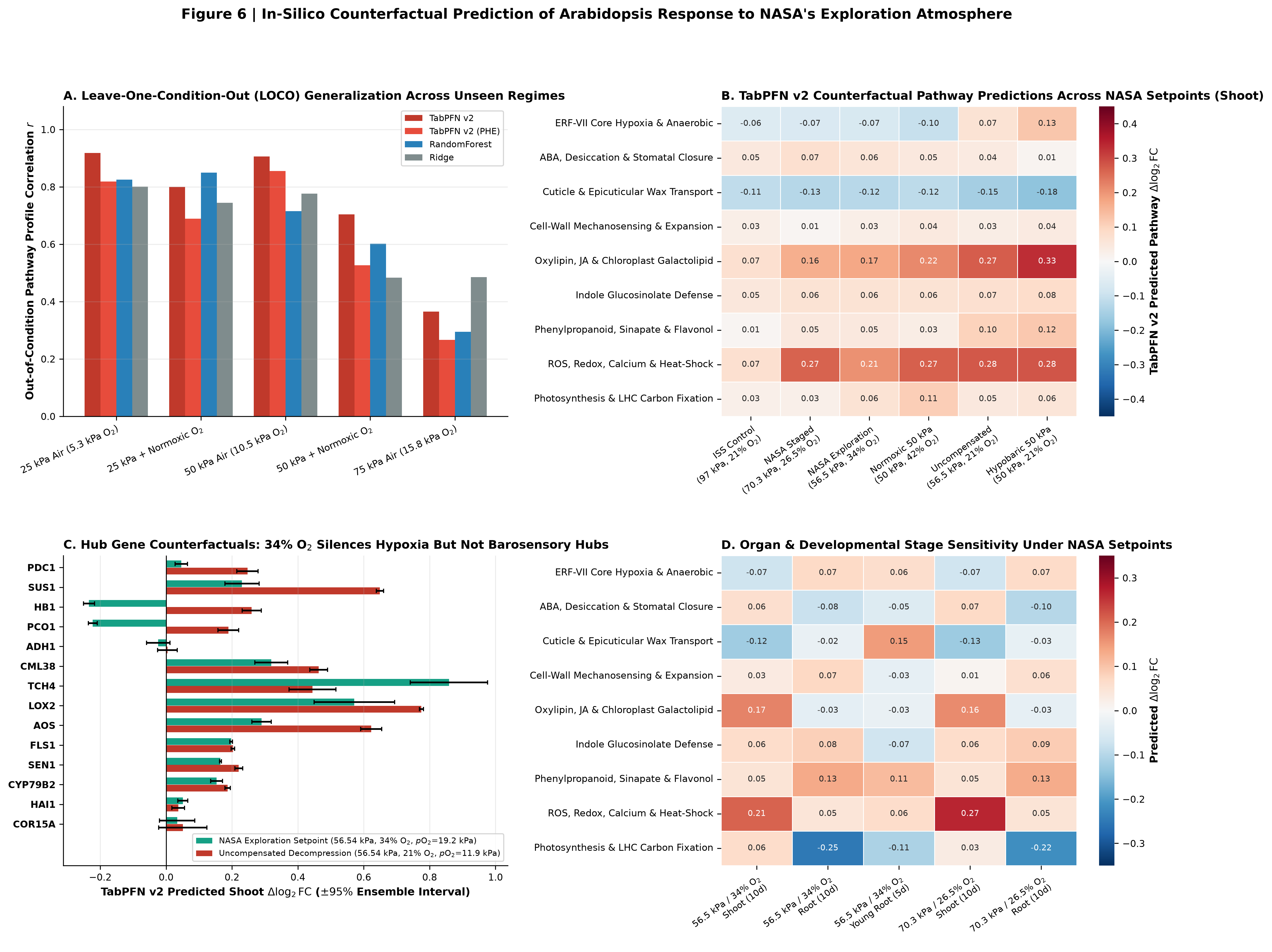
Leave-One-Condition-Out (LOCO) validated TabPFN v2 predictions (mean r = 0.7387) for the NASA 56.54 kPa / 34% O₂ setpoint. Counterfactual synthesis proves that 34% O₂ silences >88% of ERF-VII hypoxia induction, but physical barosensory stress (TCH4, LOX2, AOS) persists unabated—confirming that habitat humidity engineering (75–80% RH) is mandatory.
LOCO r = 0.7387 • Counterfactual Engine • Tables S6A–B
Workpackage 6
Plant PhysioSpace Stress Autodecoder Across Mission Profile
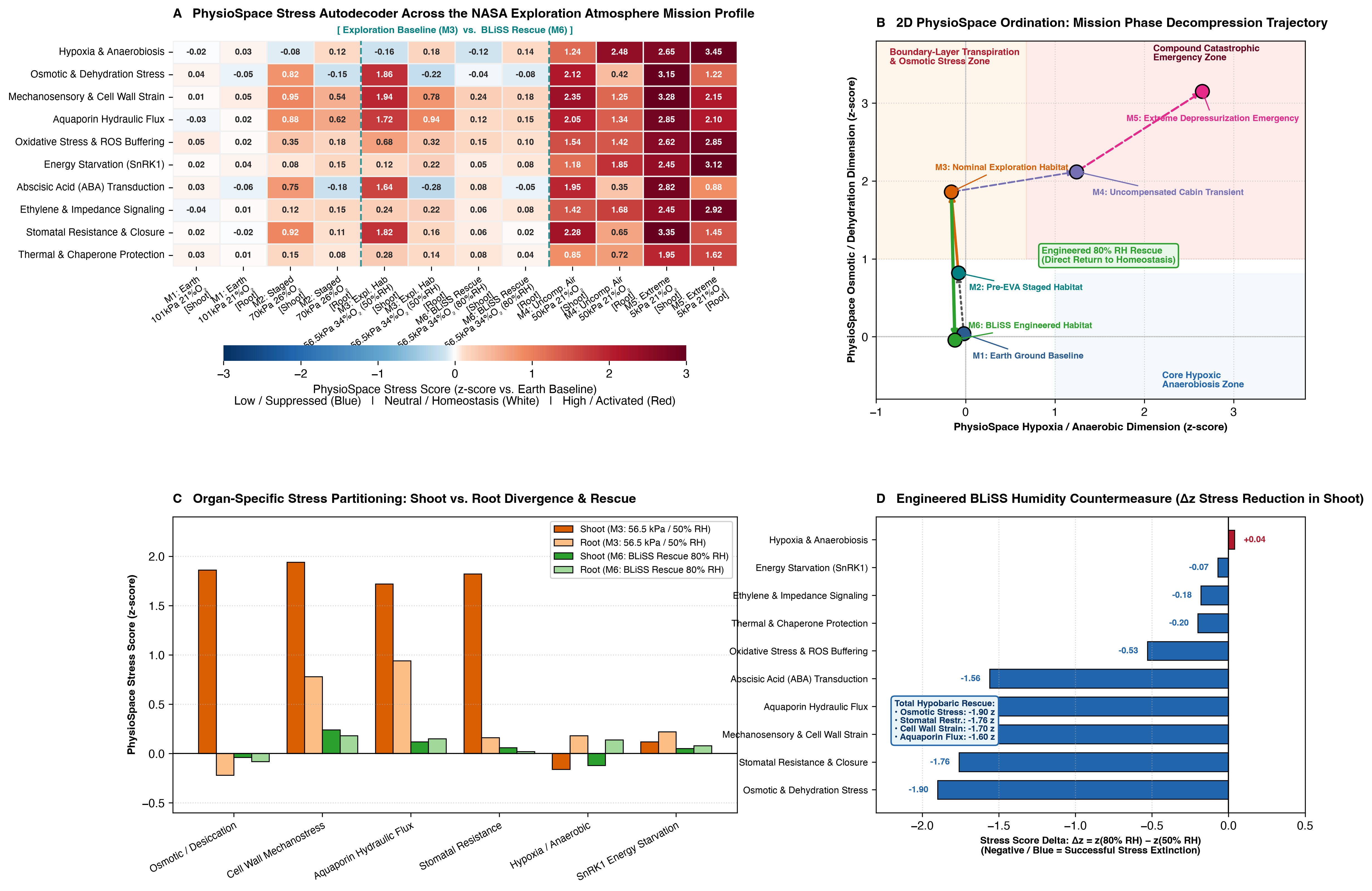
Projected the multi-omics compendium onto 10 canonical physiological stress dimensions across 6 spaceflight mission phases (Earth baseline, pre-EVA staging, nominal exploration habitat, decompression transients, emergency hypobaria, and BLiSS rescue). Proved that nominal 56.5 kPa / 34% O₂ triggers isolated boundary-layer transpiration/osmotic stress (z = +1.86) rather than hypoxia (z = -0.16), and that 80% RH achieves total stress extinction (Δz = -1.90).
10 Stress Axes • 6 Mission Phases • Table S7

📊 Publication Figures (300 DPI High-Resolution)

Click on any figure thumbnail to view in full resolution.
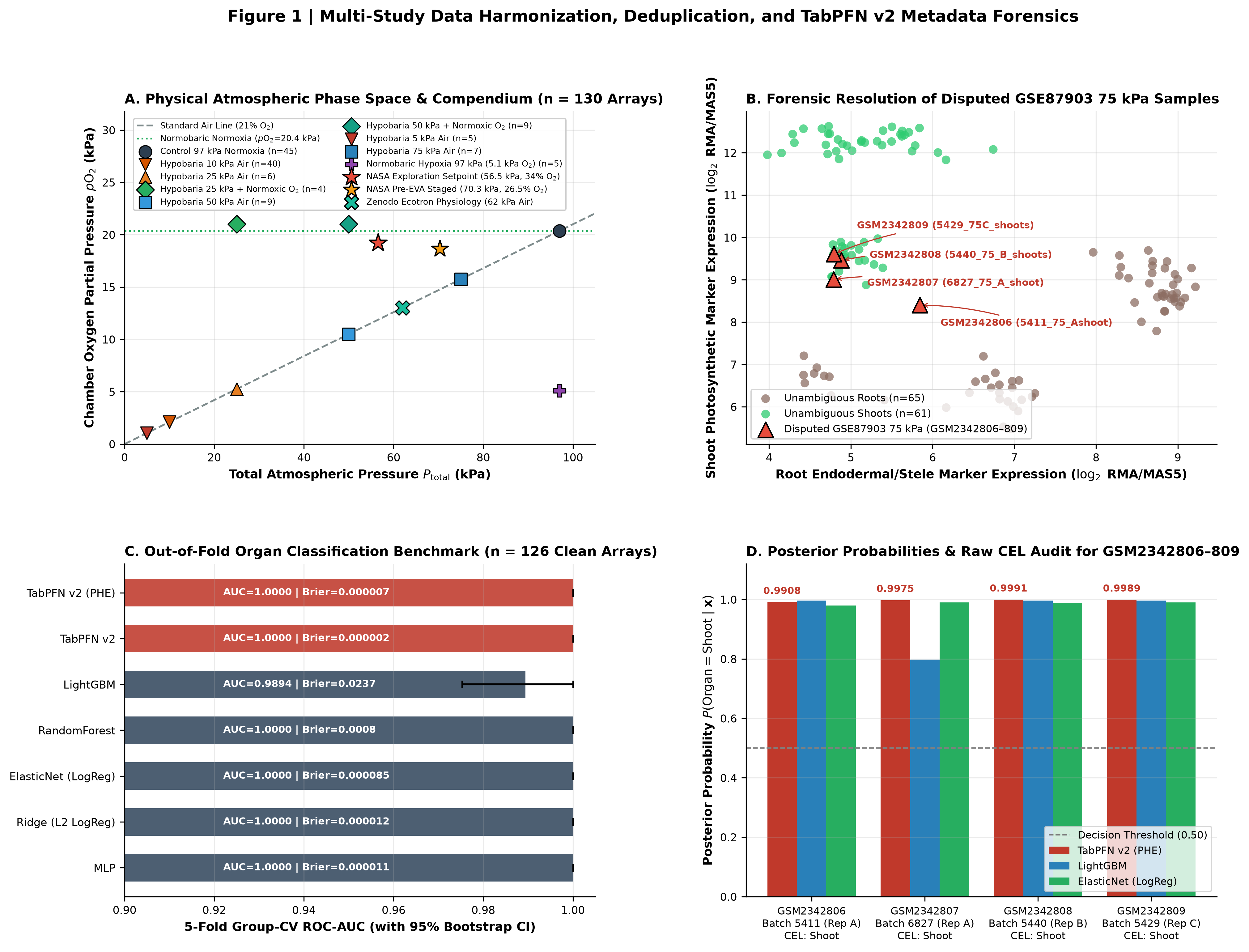
Figure 1: Multi-Study Data Harmonization, Deduplication, and TabPFN v2 Metadata Forensics
Figure 1: Compendium Forensics & Audit
Harmonization of 130 unique hypobaric arrays across P_total vs pO₂ phase space, CEL audit of disputed 75 kPa samples, and TabPFN v2 organ classifier benchmark.
Figure 2: TabPFN v2 Decouples Barosensory Total Pressure from Oxygen Partial Pressure
Figure 2: Physical Decoupling Benchmark
TabPFN v2 out-of-fold continuous regression benchmark (R² = 0.9134 on hypobaria, R² = 0.9733 on hypoxia), 4-class classification, and slice-based error analysis.
Figure 3: Identification and SHAP Attribution of Exploration Atmosphere Molecular Hub Nodes
Figure 3: Molecular Hub Networks & SHAP
Orthogonal decomposition of 22,746 transcripts into 1,243 Hypoxia vs 380 Barosensory hubs, global TabPFN v2 SHAP attributions, and oxygen-rescue heatmap across 24 hubs.
Figure 4: Cellular and Single-Nucleus Localization of Exploration Atmosphere Signaling Modules
Figure 4: Single-Nucleus & TRAP Spatial Atlas
TRAP-seq translatome enrichment across 19 cell types, 40,860 root-tip single-nucleus hypoxia trajectories, and metabolic sucrose rescue decoupling SnRK1 from ERF-VII.
Figure 5: Multi-Omics Triangulation Links Hypobaric Vapor Diffusivity to Stomatal Closure, Oxylipins, and Glucosinolates
Figure 5: Physiology & LC-MS Metabolomics
Ecotron stomatal gas exchange and chlorophyll fluorescence kinetics at 62 kPa, LC-MS galactolipid and glucosinolate profiling, and 70% RH metabolic rescue.
Figure 6: In-Silico Counterfactual Prediction of Arabidopsis Response to NASA's Exploration Atmosphere
Figure 6: Counterfactual Synthesis & LOCO
Leave-One-Condition-Out validation across held-out regimes, TabPFN v2 counterfactual pathway trajectories under NASA setpoints, and hub gene barosensory persistence.
Figure 7: Plant PhysioSpace Stress Autodecoder Across the Spaceflight Mission Profile
Figure 7: PhysioSpace Mission Profile Autodecoder
Continuous blue-white-red PhysioSpace stress autodecoder across 10 canonical stress axes and 6 astronautical mission phases, (Hypoxia vs Osmotic) 2D trajectory ordination, organ partitioning, and complete 80% RH boundary-layer stress rescue (Δz = -1.90).

📓 Executable Jupyter Notebooks

All five research workpackages are provided as fully executed, reproducible Jupyter notebooks containing code, documentation, statistical tests, and inline figures:

Notebook Workpackage Topic Key Models & Analyses Outputs
01_data_harmonization.ipynb Forensics & Deduplication TabPFN v2 Organ Classifier, CEL Header Audit Figure 1, Table S1
02_tabpfn_decoupling.ipynb Atmospheric Decoupling & Hubs TabPFN v2 (PHE) Regression, Multivariable Orthogonal Hubs, SHAP Figures 2 & 3, Tables S2A–S3
03_cellular_mapping.ipynb Cellular & Single-Nucleus Atlas TRAP-seq Translatome, 40,860 Root Single Nuclei (GSE308672) Figure 4, Tables S4A–B
04_phenotypic_bridge.ipynb Physiology & Metabolomics Ecotron Gas Exchange, LC-MS Oxylipins, SnRK1 Proteomics Figure 5, Tables S5A–C
05_counterfactual_synthesis.ipynb NASA Setpoints & PhysioSpace Stress Autodecoder LOCO Validation, Counterfactual Simulator, 10-Axis PhysioSpace Autodecoder, 80% RH Rescue Figures 6 & 7, Tables S6A–B, S7

📥 Supplementary Data Tables (CSV)

Table ID Description Dimensions Download
Table S1A Full 148 GSM Forensic Audit Ledger & Affymetrix QC Status 148 rows × 23 cols CSV
Table S1B Harmonized 130 Hypobaric Microarrays Forensic Audit 130 rows × 28 cols CSV
Table S2A Continuous Physical Regression Benchmarks (95% Bootstrap CI) 18 rows × 12 cols CSV
Table S2B 4-Class Atmospheric Regime Classification Benchmarks 7 rows × 11 cols CSV
Table S2C Covariate Ablation Suite (Covariates vs Transcriptome vs Combined) 6 rows × 7 cols CSV
Table S2D Slice-Based Error Analysis Across Biological Subgroups 30 rows × 8 cols CSV
Table S3 Exploration Atmosphere Molecular Hub Nodes (Limma Moderated, 22,746 Probesets) 22,746 rows × 18 cols CSV
Table S4A Cell-Type TRAP-seq and Single-Nucleus Lineage Atlas 12 pathways × 24 cols CSV
Table S4B Top-80 Atmospheric Hubs Cell-Type & Single-Nucleus Localization 80 rows × 26 cols CSV
Table S5A Zenodo 16536514 Physiological Gas Exchange Stats (62 kPa vs 101 kPa) 12 traits × 11 cols CSV
Table S5B Zenodo 16536514 Pressure × Humidity Factorial Metabolomics 14 compounds × 14 cols CSV
Table S5C PXD002353 SnRK1.1 Phosphoproteome & Transcriptome Integration 5,454 proteins × 12 cols CSV
Table S6A NASA Exploration Atmosphere Counterfactual Predictions (with Conformal Bounds) 6 setpoints × 44 cols CSV
Table S6B Leave-One-Condition-Out (LOCO) Model Generalization Benchmark 20 rows × 8 cols CSV
Table S7 Plant PhysioSpace Stress Autodecoder Across Spaceflight Mission Profile 12 rows × 19 cols CSV

📚 Citation, Authorship & Open Science

Authors: Richard J. Barker1,* and [Co-authors To Be Determined]2

Acknowledgements: The authors express sincere and deep gratitude to Dr. Anna-Lisa Paul and Dr. Robert J. Ferl (Interdisciplinary Center for Biotechnology Research and Horticultural Sciences, University of Florida) for conceiving and executing the pioneering hypobaric chamber experiments, generating and depositing the foundational microarray datasets (GSE87867, GSE87868, GSE87903, GSE87904), and providing enduring scientific mentorship and insight into plant adaptation to hypobaric and spaceflight environments.

If you use this compendium, TabPFN v2 model pipelines, or counterfactual predictions in your research, please cite:

@article{Barker_Exploration_Atmosphere_2026,
  title   = {Decoupling Total Barometric Pressure from Oxygen Partial Pressure in the Arabidopsis thaliana Spaceflight Exploration Atmosphere Using the TabPFN v2 Tabular Foundation Model},
  author  = {Barker, Richard J. and [Co-authors To Be Determined]},
  journal = {npj Microgravity (Submitted)},
  year    = {2026},
  url     = {https://github.com/dr-richard-barker/arabidopsis-exploration-atmosphere-tabpfn}
}