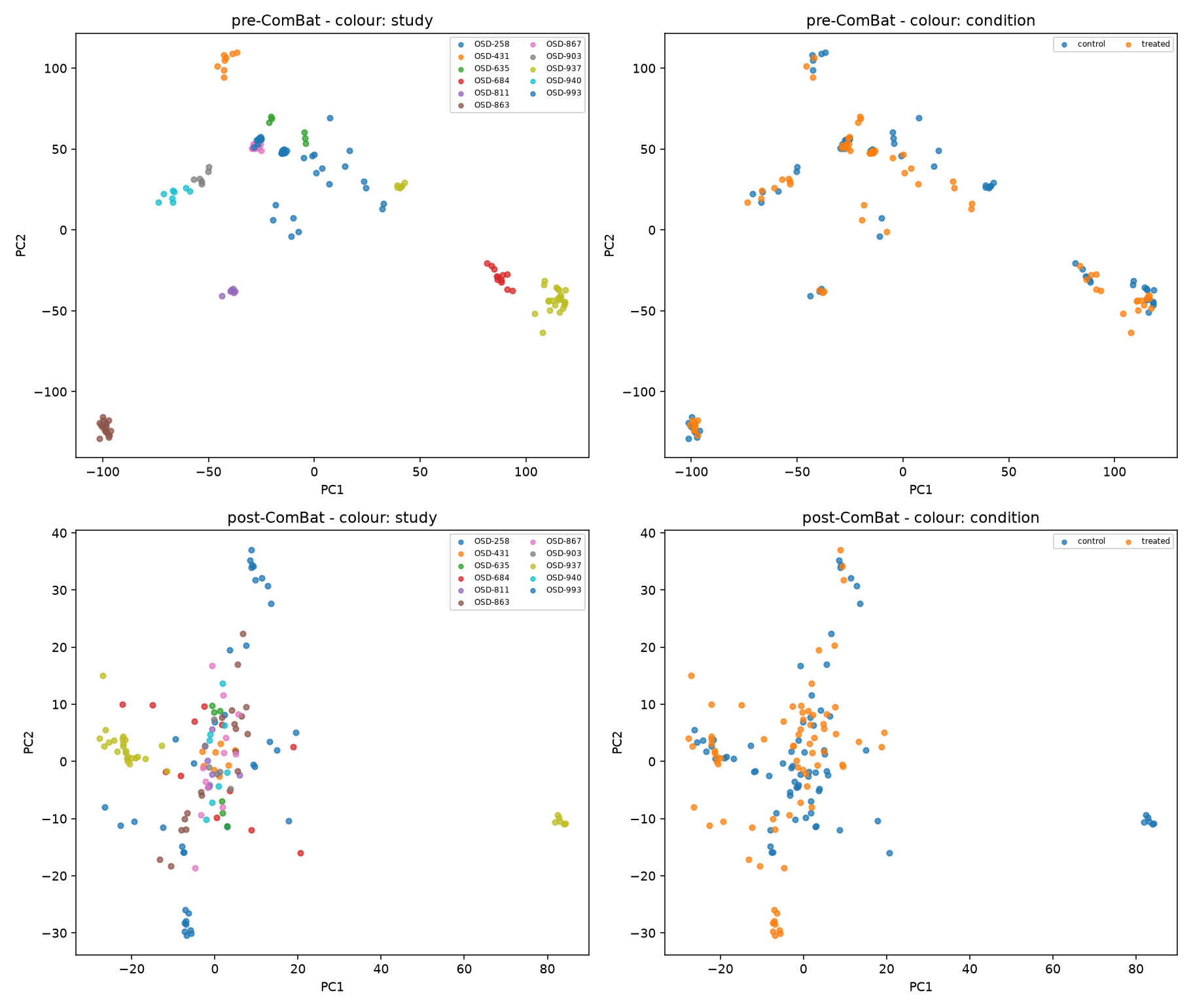
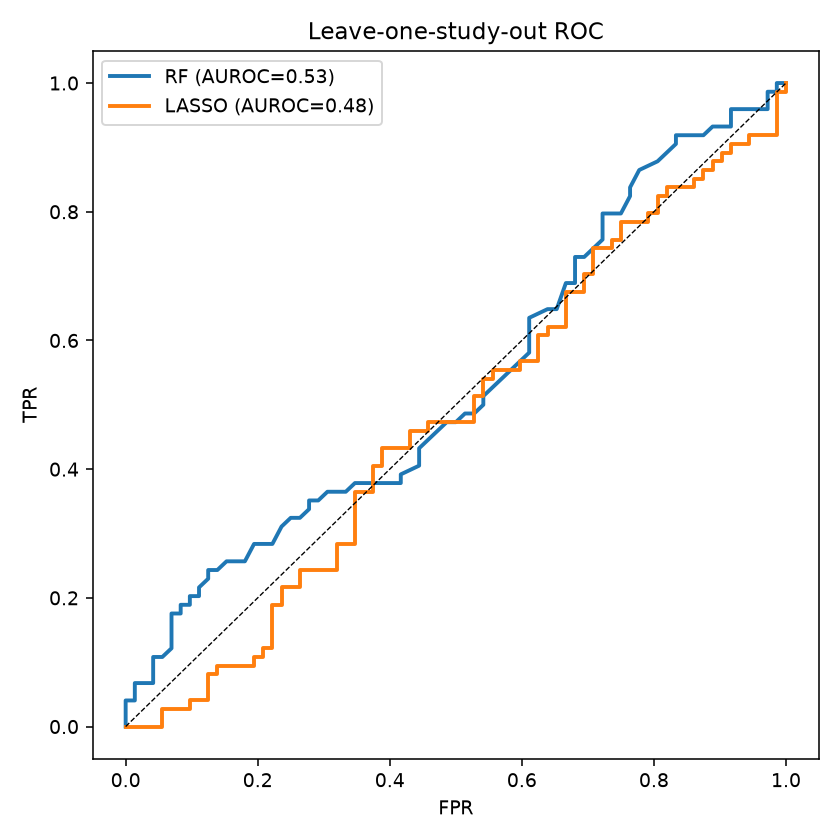
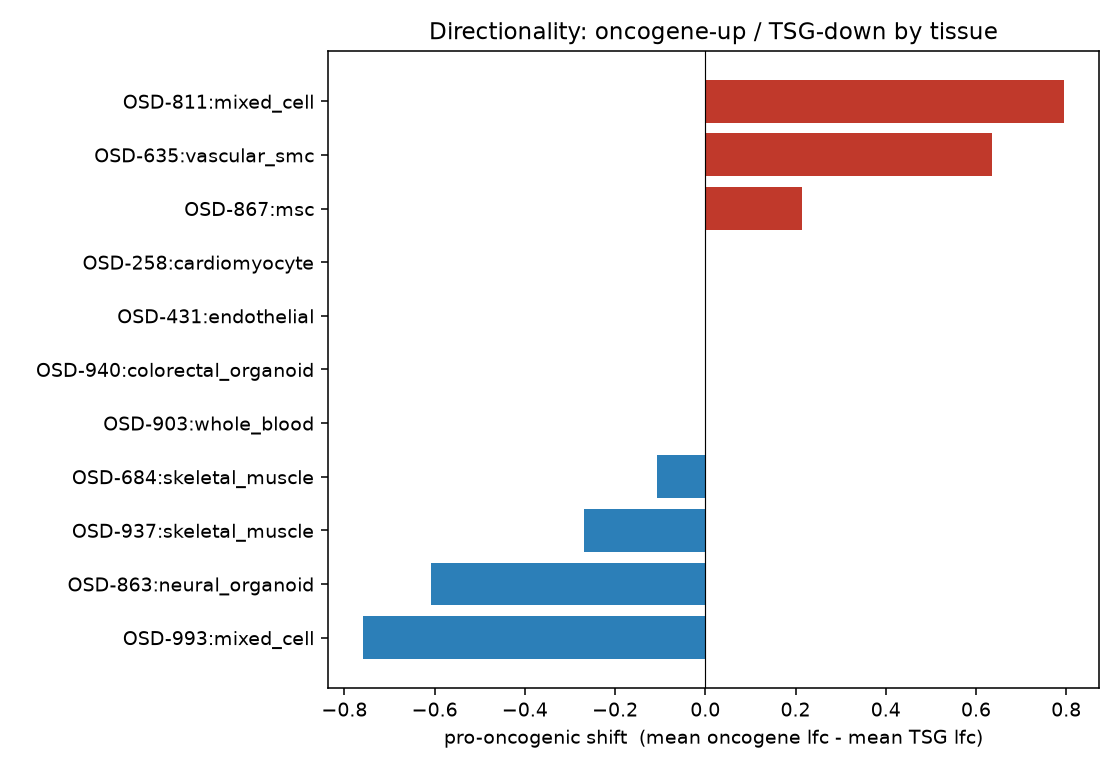
Spaceflight exposes tissues to microgravity and space radiation, stressors independently linked to proliferation, DNA-damage, senescence and immune-surveillance changes that overlap with early cancer biology. Whether these responses converge on common oncogenic programs across human tissues, and whether they yield a transferable biomarker, is unresolved. We assembled a harmonised panel of human bulk RNA-seq datasets from the NASA Open Science Data Repository spanning eleven studies and nine tissue/model systems (146 samples), integrated with a JAXA astronaut whole-blood signature, and layered supervised machine learning and oncogenic gene-set analysis on a conventional differential-expression backbone. A classifier trained to separate perturbed from control samples failed to generalise across studies (leave-one-study-out AUROC ≈ 0.5), with several tissues predicted in the opposite direction — demonstrating that no single pan-tissue transcriptomic biomarker exists. Yet each study was individually highly separable, and enrichment revealed a shared set of oncogenic programs — EMT, p53, hypoxia, inflammatory signalling, E2F, MYC and BMI1/Polycomb targets — engaged across most tissues. Critically, the direction of engagement was tissue- and stressor-specific and frequently opposite: simulated microgravity drove these programs upward (pro-oncogenic shift), whereas space radiation drove them downward, consistent with a senescence/growth-arrest response. We provide 220 tissue-specific candidate oncogene/tumour-suppressor/SASP biomarkers, and a ligand–receptor analysis shows SASP and growth-factor axes (IGF, CSF1, GDF15, IL1, PLAU, FGF, NOTCH) are among the most broadly remodelled. These results reframe the search for spaceflight cancer-risk biomarkers away from a universal signature and toward tissue-resolved panels.
Spaceflight and radiation converge on shared oncogenic programs — in tissue-specific directions
A harmonised cross-tissue meta-analysis of human spaceflight and space-radiation transcriptomes (NASA OSDR + a JAXA astronaut signature), layering supervised machine learning and oncogenic gene-set analysis on a differential-expression backbone.
Headline: there is no universal pan-tissue biomarker (leave-one-study-out AUROC ≈ 0.5), yet the same oncogenic programs (EMT, p53, hypoxia, MYC, E2F, BMI1/Polycomb) are engaged across tissues — upward under microgravity, downward under radiation — motivating tissue-resolved biomarker panels.
Abstract
Highlights
Harmonised panel
11 OSDR studies · 9 tissue/model systems · 146 samples, integrated with a JAXA astronaut whole-blood signature.
No universal biomarker
Leave-one-study-out AUROC ≈ 0.5; several tissues predicted in the opposite direction — no single pan-tissue signature.
Shared programs, opposite directions
EMT, p53, hypoxia, MYC, E2F, BMI1/Polycomb engaged across tissues — up under microgravity, down under radiation.
Tissue-resolved panels
220 tissue-specific candidate oncogene/TSG/SASP biomarkers; SASP & growth-factor axes broadly remodelled.
Selected figures
Data & code
- Manuscript:
manuscript/manuscript.md· supplementary - Pipeline:
src/· one-commandrun_all.py - Results:
results/(DE, LOSO, enrichment, biomarker panels, ligand–receptor) - Figures:
manuscript/figures/
Data derive from NASA OSDR (eleven human studies) and a JAXA astronaut whole-blood signature; cite the individual accessions. OSDR data remain subject to the NASA Open Data policy. Companion to Astronaut Health Search (the opposite-forcing drug-reversal analysis).