Which seed cell types and developmental stages are susceptible to deep-space stressors?
Two reusable, FAIR tools and a single-cell seed-susceptibility atlas for plant space biology, built on Arabidopsis. Give the decoder a bulk transcriptomic signature; it recognises which space stressor the signature resembles and predicts its effect on the dry and germinating seed, cell type by cell type. Companion to a manuscript targeted at npj Microgravity.
| 27 contrasts | 10 stressor families | 123 seed panels | 9 / 10 families hit the root cap | |:—:|:—:|:—:|:—:|
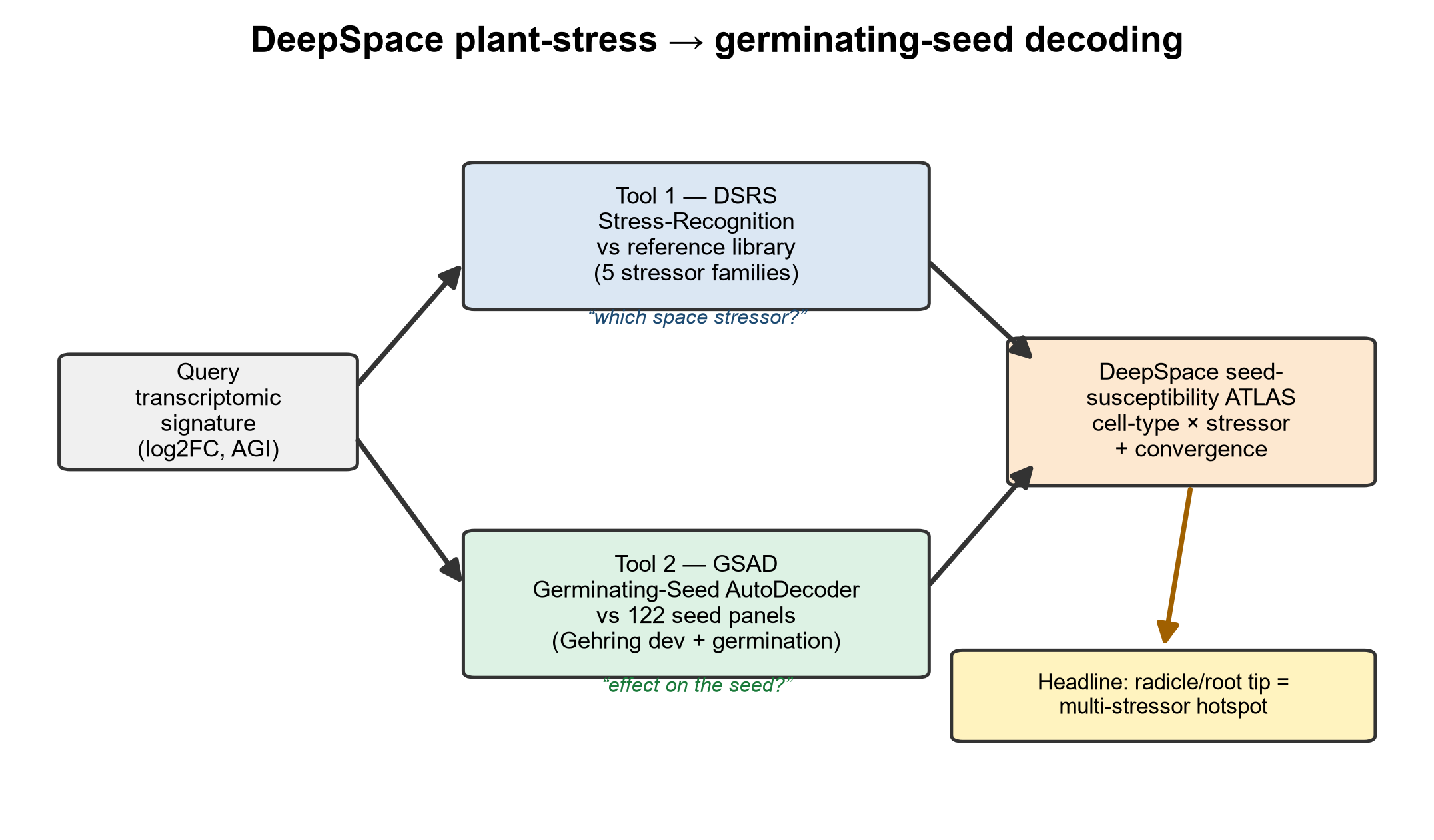
Figure 1 — Concept workflow. A single query signature drives both tools; their outputs assemble into the cell-type × stressor susceptibility atlas and its convergence metric.
The question
Deep-space environments combine microgravity, chronic ionizing radiation, a near-absent or altered magnetic field, and the confined, potentially hypoxic gas environment of flight hardware — and the loss of a stable gravity vector removes the gravitropic set-point that organises seedling establishment. Each stressor has documented effects on adult plant transcriptomes, but the consequences for the dry/dormant and germinating seed — the stage that determines whether a crop establishes at all — are poorly resolved, because spaceflight experiments sample seedlings and organs rather than seeds. This project bridges that gap by projecting stressor signatures onto a single-cell seed reference.
The two tools
Both tools rank a query signature by log2 fold-change and project it onto the seed panels by pre-ranked gene-set enrichment. They differ only in what they ask of the result.
| Tool | What it does | Question |
|---|---|---|
| DSRS — DeepSpace Stress-Recognition System | Recognise which space stressor a signature most resembles across the reference families (gravity, radiation, low-oxygen, tropism, desiccation, osmotic, ethylene, temperature, UV). | “Which space stressor is this?” |
| GSAD — Germinating-Seed AutoDecoder | Predict a bulk transcriptome’s effect on the dry / germinating seed — a per cell-type, per-tissue, per-stage susceptibility profile against the 123-panel reference. | “What does it do to the seed?” |
Input is a two-column CSV: gene (AGI/TAIR, e.g. AT1G01010) and log2FC.
# install
cd tools && pip install -e .

# which space stressor does my signature resemble?
deepspace dsrs my_signature.csv --out matches.csv

# predicted effect on the dry / germinating seed
deepspace gsad my_signature.csv --out seed_susceptibility.csv
# or from Python
import deepspace
top, fam = deepspace.dsrs.recognize("my_signature.csv")   # which stressor?
seed     = deepspace.gsad.decode("my_signature.csv")       # effect on the seed
seed["celltype"].head()                                    # ranked cell-type susceptibility
Outputs are predicted concordance (signature transfer across tissue and stage), not proven causation — every claim carries an evidence tier and a falsification test.
A validated single-cell seed reference
The reference is a 123-panel library — 122 single-cell marker panels from the developmental seed atlas (snRNA-seq, 3/5/7 days after pollination) and the germination atlas (scRNA-seq, 12/24/48 h post-imbibition), plus a bulk dry-seed anchor. Panels reproduce canonical markers (oleosins and cruciferin for embryo, BANYULS for the inner-integument endothelium).
As a stringent positive control, the decoder was restricted to embryo cells and asked which germinating-seed cell type each developing-embryo state maps onto. It independently recovers established developmental lineages from transcriptomes alone:
- protoderm → epidermis
- hypophysis → radicle apical meristem — placing the embryonic hypophysis as the developmental origin of the radicle growth-point
- vascular primordium → provasculature
- inner cotyledon → cotyledon mesophyll, and cortical initials → hypocotyl cortex
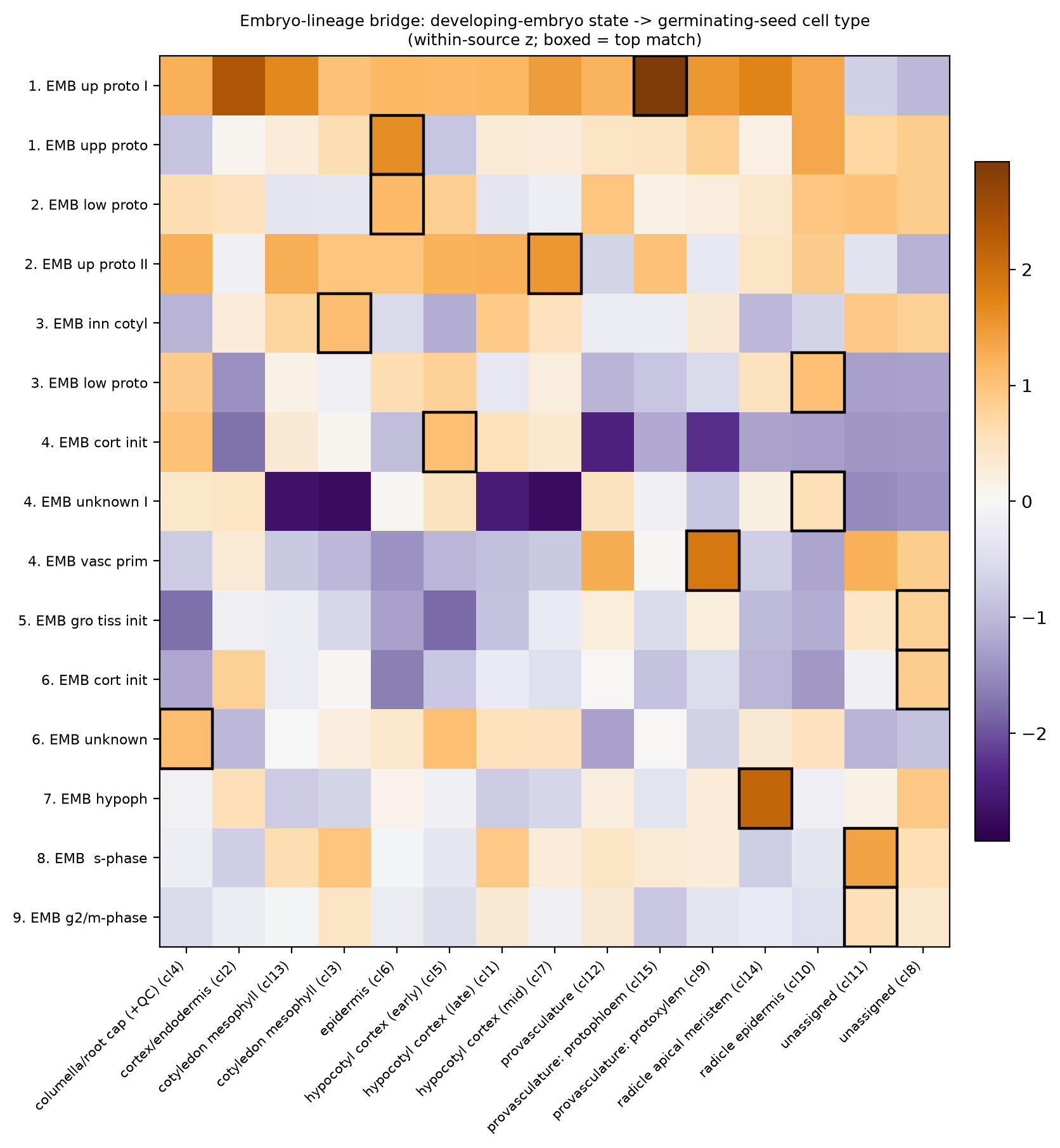
Figure 3 — Validated seed reference. Recovering ground-truth embryo→seedling lineages confirms the projection machinery reflects real cell-type biology rather than artefact.
The deep-space stress library
Genome-wide signatures span ten stressor families, assembled from public NASA OSDR and GEO/AtGenExpress datasets. A recurrent theme: stressed adult/vegetative tissue transcriptionally resembles the early-germination (12 h) state, suggesting a shared stress-engaged program at the onset of germination.
| Family | Represented by |
|---|---|
| Gravity | spaceflight microgravity (root & leaf) + 2 g hypergravity — the µg↔1 g↔hypergravity axis |
| Radiation | GCR-relevant low-dose, acute γ |
| Tropism | gravitropism, phototropism |
| Low-oxygen | hypoxia, anoxia, submergence |
| Desiccation | seed maturation drying |
| Osmotic | mannitol |
| Ethylene | ACC |
| Temperature | warm / thermomorphogenesis |
| UV | UV-B |
| Magnetic / null field | curated NMF panel, handled by expression-localization (not GSEA) |
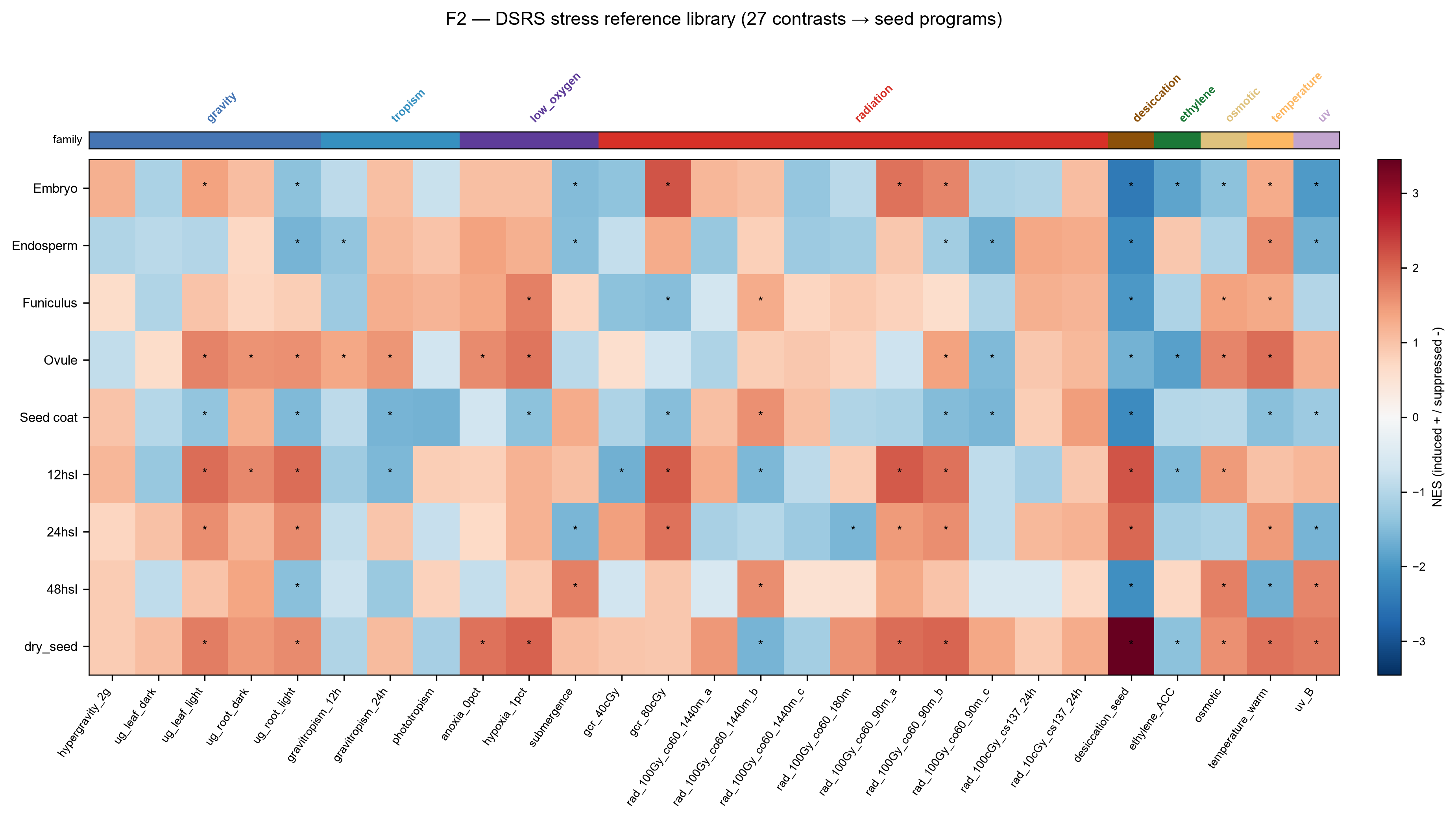
Figure 2 — DSRS stress library. Each contrast’s seed-program fingerprint across the reference panels; DSRS matches a query to this library.
Headline result: the root tip is the multi-stressor convergence apex
Scoring each germinating-seed cell type by how many of the ten stressor families significantly target it — a family-level metric so no single data-rich family dominates — gives an unambiguous result.
- Columella / root cap — 9 of 10 families. Targeted by more stressor families than any other biologically-defined germinating-seed cell type.
- Radicle apical meristem — the specific null-magnetic-field target (localization z = +7.96); radicle epidermis completes a broadly susceptible root pole. Hypocotyl cortex and cotyledon mesophyll are secondary hotspots (6–7/10).
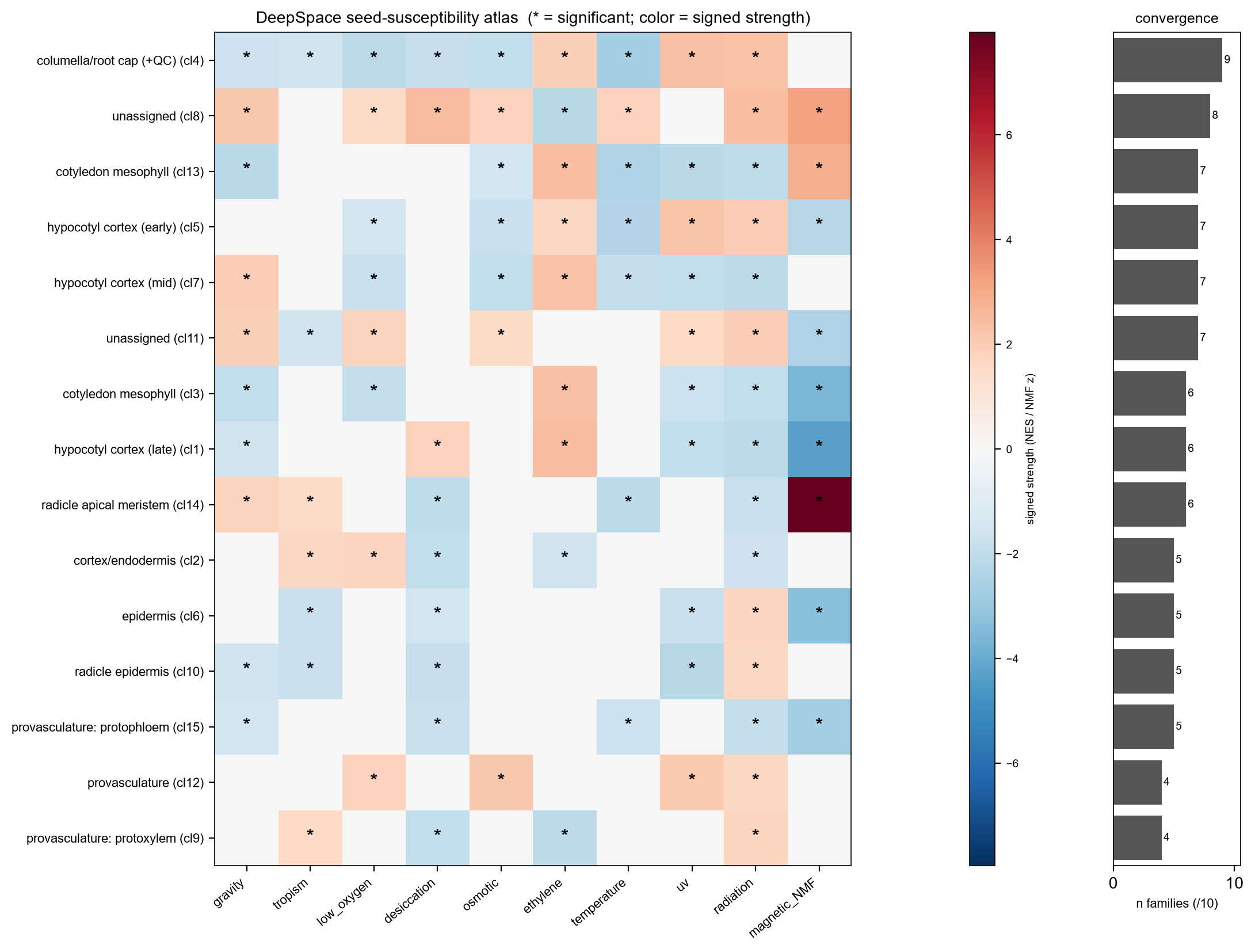
Figure 5 — The DeepSpace seed-susceptibility atlas. Rows are germinating-seed cell types, columns the ten stressor families; colour is signed strength (NES / NMF z) and * marks significance. The right-hand bars count how many families reach each cell type. Early germination (12 h) is the most multi-stressor-vulnerable developmental window.
A convergent model centred on the radicle growth-point
Four independent lines converge on the radicle growth-point:
- Null magnetic field — NMF-responsive genes localise to the radicle apical meristem (z = +7.96).
- Microgravity — modulates the radicle-meristem program in a light-gated manner.
- Gravitropism — itself a root-tip phenomenon, engages the same program.
- Development — the structure is founded by the embryonic hypophysis, which the lineage analysis maps directly onto the radicle apical meristem.
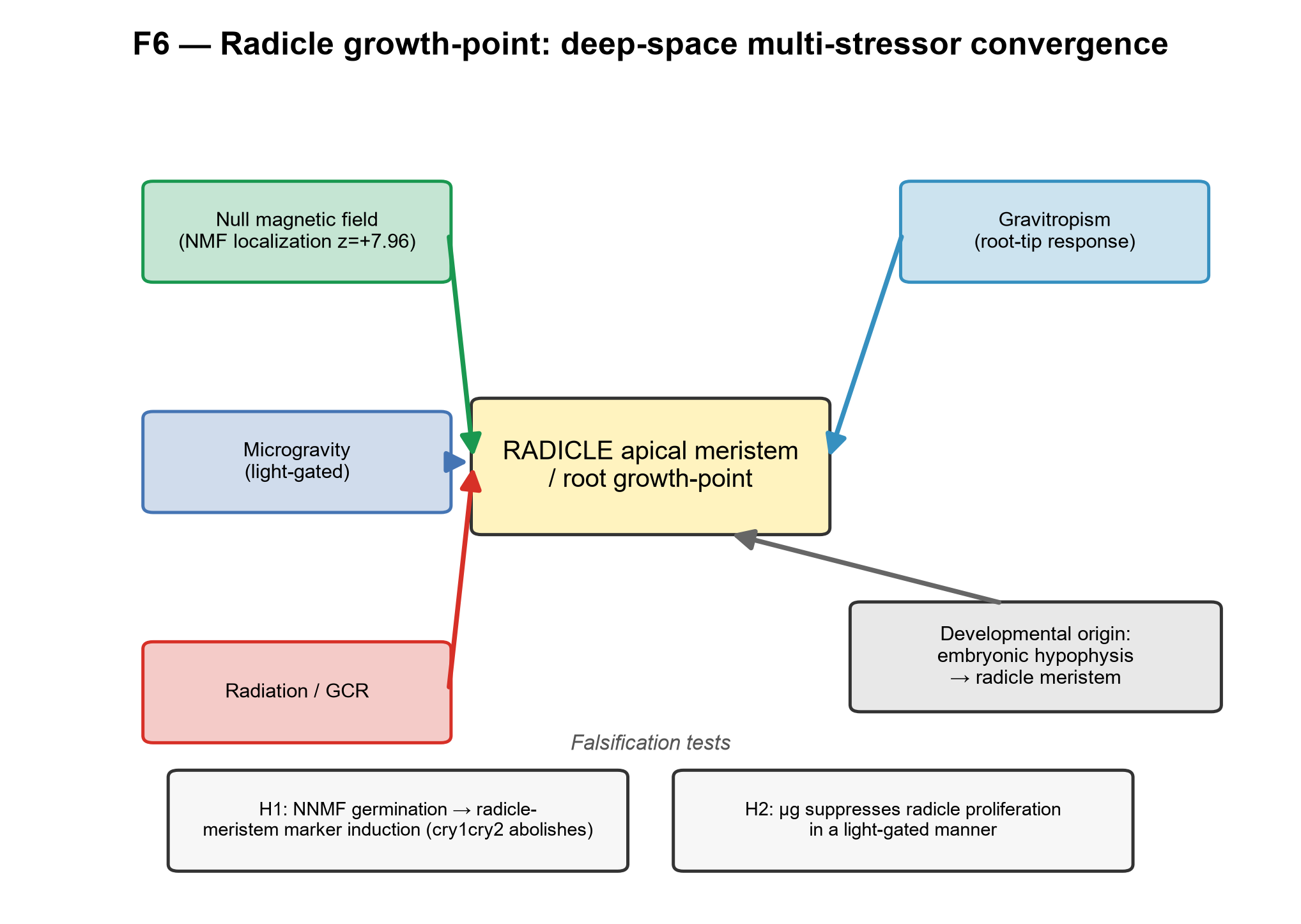
Figure 6 — Convergent model & falsification tests. The radicle apical meristem is proposed as a priority cellular target for deep-space seed performance, with two high-confidence, falsifiable predictions — H1: near-null magnetic field induces radicle-meristem markers and alters radicle emergence, abolished in _cry1 cry2_; H2: microgravity suppresses radicle proliferative programs in a light-gated manner.
All predictions are framed as concordance, not causation. GSAD performs signature transfer across tissue and developmental stage, so each claim carries an evidence tier (direct data / atlas projection / literature / hypothesis) and an explicit experiment that would refute it.
Reproduce
Every input is public; the pipeline is numbered end-to-end.
- Environment. Python ≥3.10 (
pip install -r requirements.txt); R ≥4.4 + SeuratObject to open and export the developmental atlas;cd tools && pip install -e .for thedeepspaceCLI. - Data. Download from accessions in
data/data_inventory.csv(see the table below). - Pipeline. Run the numbered scripts
01–30in order — build panels → project each stressor family → NMF localization → bridge/lineage validation → atlas → figures → manuscript. - Use the tools on your own signature with
deepspace dsrs/deepspace gsad.
Determinism: GSEA-prerank uses a fixed seed (42) and 200 permutations; gene IDs are harmonised to AGI/TAIR. Full guide in REPRODUCE.md; the complete living dev log is in PLANNING.md.
Data & accessions
Full provenance is in
data/data_inventory.csv.
The one exception is the genome-wide null-magnetic-field arrays, which are not publicly deposited — that arm
relies on a curated localization-tier gene panel while a request to the source authors is outstanding.
| Role | Dataset | Accession | Repository / platform |
|---|---|---|---|
| Seed reference | Developmental seed atlas (3/5/7 DAP) | GSE295007 | GEO · snRNA-seq |
| Seed reference | Germination atlas (12/24/48 h) | GSE182331 · E-MTAB-12532 | GEO / ArrayExpress · scRNA-seq |
| Gravity — microgravity | Spaceflight root; leaf | OSD-120; OSD-678 | NASA OSDR · RNA-seq |
| Gravity — hypergravity | 2 g vs 1 g callus | GSE29787 | GEO · Agilent GPL9020 |
| Radiation — GCR | Whole seedling 40/80 cGy | OSD-658 | NASA OSDR · RNA-seq |
| Radiation — acute γ | 100 Gy Co-60 time-course | OSD-498/502/508/510 | NASA OSDR · RNA-seq |
| Radiation — low-dose | Cs-137, 10 & 100 cGy | OSD-782 | NASA OSDR · RNA-seq |
| Low-oxygen | Hypoxia/anoxia; submergence | GSE315308; GSE182724 | GEO · RNA-seq |
| Tropism — gravitropism | Root gravistimulation time-course | GSE199142 | GEO · RNA-seq |
| Tropism — phototropism | Auxin/tropic-growth gradient | GSE3847 | GEO · ATH1 GPL198 |
| Desiccation | Seed maturation drying (21 vs 15 DAF) | GSE76015 | GEO |
| Ethylene | ACC 4 h vs 0 h | GSE193833 | GEO |
| Temperature | 27 vs 21 °C (thermomorphogenesis) | GSE303133 | GEO |
| Osmotic; UV-B | Mannitol; UV-B vs control | GSE5622; GSE5626 vs GSE5620 | AtGenExpress · ATH1 GPL198 |
| Magnetic / null field | NNMF arrays (Parmagnani/Maffei 2022; Agliassa/Maffei 2021) | not deposited — curated panel | Journal supplement · localization-tier |
| Cross-check | Mature-root eFP map (Brady et al. 2007) | GSE8934 | GEO · ATH1 GPL198 |
Cite
Released under the MIT license; a Zenodo DOI will be minted on deposit. Machine-readable metadata in CITATION.cff.
Software / dataset (replace the Zenodo DOI once minted on deposit):
@software{barker_deepspace_2026,
  author    = {Barker, Richard},
  title     = {{DeepSpace Plant-Stress to Germinating-Seed Decoder
               (DSRS + GSAD) and seed-susceptibility atlas}},
  year      = {2026},
  version   = {0.1.0},
  license   = {MIT},
  publisher = {Zenodo},
  doi       = {10.5281/zenodo.0000000},
  url       = {https://github.com/dr-richard-barker/deepspace-seed-stress-decoder}
}
Companion manuscript (draft, targeted at npj Microgravity):
@article{barker_seed_susceptibility_2026,
  author  = {Barker, Richard},
  title   = {{A cell-type-resolved atlas of deep-space stress susceptibility
             in the dry and germinating Arabidopsis seed}},
  year    = {2026},
  journal = {npj Microgravity},
  note    = {Manuscript in preparation}
}
Author: Richard Barker — Purdue University; The Collaborative Science Environment, PBC.
All decoder outputs are predicted concordance from cross-stage signature transfer, not proven causation; claims carry evidence tiers and falsification tests. Manuscript draft targeted at npj Microgravity.